
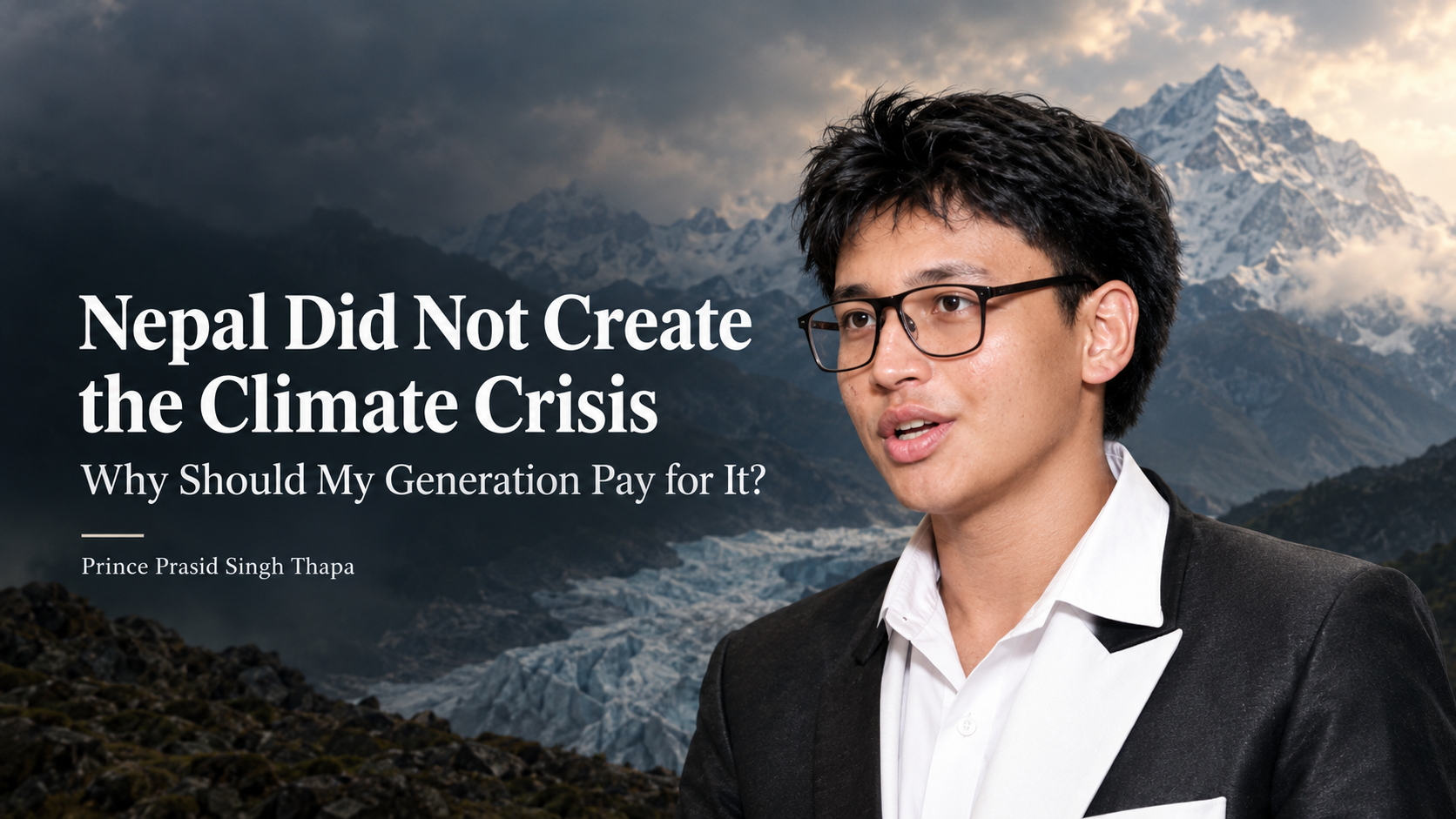
As a 15 year-old Nepali, I am asking wealthy nations for more than sympathy. Countries on the front lines of climate change need justice, responsibility and a fair means of rebuilding what they did so little to endanger.
My generation did not spend decades filling the atmosphere with greenhouse gases. Nepal did not build its prosperity through centuries of fossil-fuel-driven industrialization. Yet it is young people like me who may spend much of our lives confronting the consequences of a crisis we inherited rather than created.
I come from Nepal, home to Mount Everest and some of the most extraordinary Himalayan landscapes on Earth. Too much of the outside world, our mountains represent beauty, adventure and human courage.
To us, they are something more fundamental.
They are home.
And that home is becoming increasingly vulnerable in a warming world.
Where credible scientific evidence demonstrates that human-caused climate change has contributed to serious loss and damage, vulnerable countries should have access to meaningful international support, with grant-based finance playing a central role so that recovery does not simply deepen unsustainable debt.
Floods, landslides, extreme rainfall, rising temperatures and changes in snow, ice and water systems threaten communities, infrastructure, agriculture and livelihoods across Nepal.
Climate change does not cause every disaster in my country. To suggest otherwise would be scientifically careless. Geography, inadequate planning, unsafe development and weak governance can all intensify disaster risk.
But acknowledging those realities does not erase another one: human-caused climate change is altering the conditions in which these hazards occur and increasing risks for vulnerable communities around the world.
That leaves me with a question I believe global leaders have an obligation to answer: Why should those who contributed least to this crisis be expected to bear some of its greatest costs?
Sympathy Is Not Justice
When disaster strikes Nepal, the international community often responds with compassion.
Governments issue statements of condolence. Humanitarian organizations mobilize. Emergency supplies arrive. Images of destroyed homes, damaged roads and grieving families briefly enter the international news cycle.
Then the world’s attention moves elsewhere.
But disaster survivors do not have the luxury of moving on with the news cycle.
The house is still gone.
The bridge still needs to be rebuilt.
The farmer may have lost land that sustained a family for generations.
A child may have lost a school or a parent.
A community can lose in a few hours what took decades to build.
Emergency relief matters enormously. It saves lives and protects human dignity in moments of crisis.
But relief and justice are not the same thing.
A bag of rice cannot rebuild a bridge.
A temporary shelter cannot replace a family’s home.
A statement of sympathy cannot reconstruct a school.
And another loan cannot resolve climate injustice.
Why Should We Borrow to Rebuild?
This is one of the deepest contradictions in the global response to climate change.
Consider a developing country that has contributed relatively little to historical greenhouse-gas emissions. It faces growing climate risks. A catastrophic event destroys homes, roads, schools, farmsand essential infrastructure. Rebuilding requires resources far beyond what the country can immediately afford.
What happens next?
Too often, the answer is debt.
The vulnerable country borrows to reconstruct what has been destroyed.
The financial burden then passes into the future.
That means a child who did not create the climate crisis can inherit both its physical consequences and the debt accumulated while responding to them.
I struggle to see the justice in that.
The international community has already recognized the importance of addressing climate-related loss and damage. That recognition matters. But international agreements have meaning only when they translate into real support for people and countries facing real losses.
Climate finance must therefore be accessible, adequate and responsive to the needs of vulnerable countries.
Where credible scientific evidence establishes that human-caused climate change contributed to loss and damage, international support should not merely create another cycle of indebtedness.
Nepal needs humanitarian assistance when disaster strikes.
But what we need beyond humanitarian assistance is justice.
Climate Justice Does Not Excuse Nepal’s Own Failures Demanding international responsibility does not absolve Nepal of responsibility at home.
We have failures of our own, and credibility requires us to acknowledge them.
Poorly engineered roads can destabilize fragile hillsides. Construction in vulnerable areas can magnify risk. River encroachment, weak environmental enforcement, unplanned urbanization and inadequate disaster preparedness can transform hazards into catastrophes.
We cannot attribute those failures to wealthy countries.
They are ours to confront.
Nepal must strengthen early-warning systems, enforce responsible land-use planning, protect forests and watersheds, invest in climate-resilient infrastructure and hold institutions accountable for development that unnecessarily places lives at risk.
The same principle must apply to climate finance.
If international funds come to Nepal, every rupee should be traceable.
How much reached affected families?
How much strengthened vulnerable communities?
How much rebuilt schools, hospitals and infrastructure to higher standards?
How much was consumed by bureaucracy, inefficient administration or unnecessary consultancy?
And how much, if any, disappeared because of corruption or poor governance?
A country cannot credibly demand accountability internationally while refusing to practice it domestically.
That is not an argument against climate finance.
It is an argument for climate finance that is transparent, effective and accountable.
If we demand responsibility from the world, we must demonstrate responsibility ourselves.
The Himalayas Are Not Nepal’s Concern Alone
There is another reason Nepal’s climate future should matter far beyond our borders.
The Himalayas are not simply dramatic scenery for tourism campaigns.
Their glaciers, snow, rivers and ecosystems are deeply connected to water security, biodiversity, food systems, energy and livelihoods across a vast region.
Mount Everest occupies a special place in the global imagination. People from every continent travel to Nepal to see it, climb it or simply stand in its presence.
The world celebrates Everest as a symbol of human ambition and endurance.
That raises another question: If the world claims the Himalayas as part of our shared natural heritage, why should protecting their future be treated as Nepal’s burden alone?
We cannot celebrate the mountains while ignoring the vulnerability of the communities living beneath them.
The consequences of environmental change do not stop at political borders. What happens in the Himalayas carries significance far beyond Nepal.
Protecting them is therefore not merely a Nepali concern. It is part of a much larger regional and global responsibility.
Evidence Must Strengthen Our Argument
Nepal must also become more rigorous in the way it makes its case internationally.
Emotion has a place in climate discussions. Behind every statistic is a human life, a family or a community.
But emotion cannot substitute for evidence.
After major disasters, Nepal should systematically document what was lost: homes, roads, bridges, schools, hospitals, farms, businesses, cultural heritage and livelihoods.
We need credible assessments of economic and non-economic loss.
We need stronger scientific capacity.
My generation did not spend decades filling the atmosphere with greenhouse gases. Nepal did not build its prosperity through centuries of fossil-fuel-driven industrialization. Yet it is young people like me who may spend much of our lives confronting the consequences of a crisis we inherited rather than created.
And where possible, researchers should examine the extent to which human-caused climate change altered the probability or severity of particular extreme events.
Nepal should not exaggerate its claims.
Exaggeration may attract attention temporarily, but evidence builds credibility.
Our case should be strong enough to withstand scrutiny.
Then Nepal can enter international negotiations and say:
Here is the damage.
Here is the evidence.
Here is what our country did to reduce its own vulnerability.
Here is what could not reasonably have been prevented.
Now let us discuss responsibility.
Nepal should also work alongside least-developed countries, small island developing states, mountain nations and other climate-vulnerable communities.
A small country speaking alone can be ignored.
A coalition of vulnerable nations can be harder to dismiss.
And a generation demanding fairness may be harder still.
I Am the Future Generation Leaders Keep Talking About World leaders frequently speak of their responsibility to “future generations.”
Whenever I hear that phrase, I am reminded of something very simple:
We are already here.
I am part of that future generation.
By 2050, I will be only 39 years old.
The decisions being made today in parliaments, ministries, boardrooms and international negotiating halls will shape most of my adult life.
Will Nepal repeatedly have to borrow money to reconstruct what disasters destroy?
Will vulnerable countries be forced to choose between building schools and hospitals and repairing damaged roads and bridges?
Will my generation inherit meaningful international climate cooperation?
Or will we inherit climate debt?
These are not theoretical policy questions for young people.
They concern the lives we will actually live.
They concern the economies in which we will work, the communities in which we will raise families and the planet on which we will grow old.
When today’s leaders speak about the future, they are speaking about our present.
We Are Not Asking for Charity
Nepal should never approach the international community as a helpless victim.
We have agency. We have responsibilities. And we must fulfil them.
We must improve governance, strengthen disaster preparedness, protect our environment, build more responsibly and ensure that public and international resources are used transparently.
But responsibility cannot end at Nepal’s borders.
Countries with far greater historical emissions and far greater financial capacity also have responsibilities.
This is not about blaming ordinary citizens in wealthy countries for decisions made over generations.
Nor am I suggesting that the international community should pay for every flood, every landslide or every failure of governance in Nepal.
The principle I am arguing for is more reasonable than that:
Responsibility should reflect contribution, capacity and need.
Where credible scientific evidence demonstrates that human-caused climate change has contributed to serious loss and damage, vulnerable countries should have access to meaningful international support, with grant-based finance playing a central role so that recovery does not simply deepen unsustainable debt.
Do not offer us sympathy and leave us with the bill.
Do not admire our mountains while overlooking the people who live beneath them.
And do not tell my generation that the answer to a crisis we did not create is to borrow money that we will spend our adulthood repaying.
I am 15 years old.
I am a student, actor, model, motivational speaker, programme host, youth social activist and founder of Prince Foundation.
But before any of those descriptions, I am a young Nepali thinking about the country and the world I will inherit.
I do not want Nepal to escape responsibility for its own failures.
I want us to confront them.
I want my country to build better, govern better, prepare better and protect its people better.
But I also want the international system to recognize a truth that should not be controversial:
Those who contributed least to a crisis should not be abandoned to bear its greatest consequences alone.
My message to world leaders is therefore simple.
Nepal needs relief when disaster strikes.
But Nepal deserves more than relief.
We need responsibility.
We need accessible and adequate climate finance.
We need serious investment in adaptation and resilience.
We need accountability both internationally and at home.
And where human-caused climate change contributes to measurable loss and damage, vulnerable countries deserve meaningful support to recover without transferring the financial burden to children who had no role in creating the crisis.
Climate justice is not charity.
It is fairness between countries.
It is fairness between generations.
It is the recognition that responsibility cannot be separated from consequence.
And ultimately, it is a promise that the children who contributed least to this crisis will not be forced to pay its highest price.
Writer
Prince Prasid Singh Thapa is a 15-year old Nepali student at Rupy’s International School, an actor, model, motivational speaker, programme host, youth social activist, and founder of the Prince Foundation. Through his writing and advocacy, he speaks on youth empowerment, social responsibility, humanitarian issues, and climate justice.
Publish Date: September 6, 2026






Feedback