
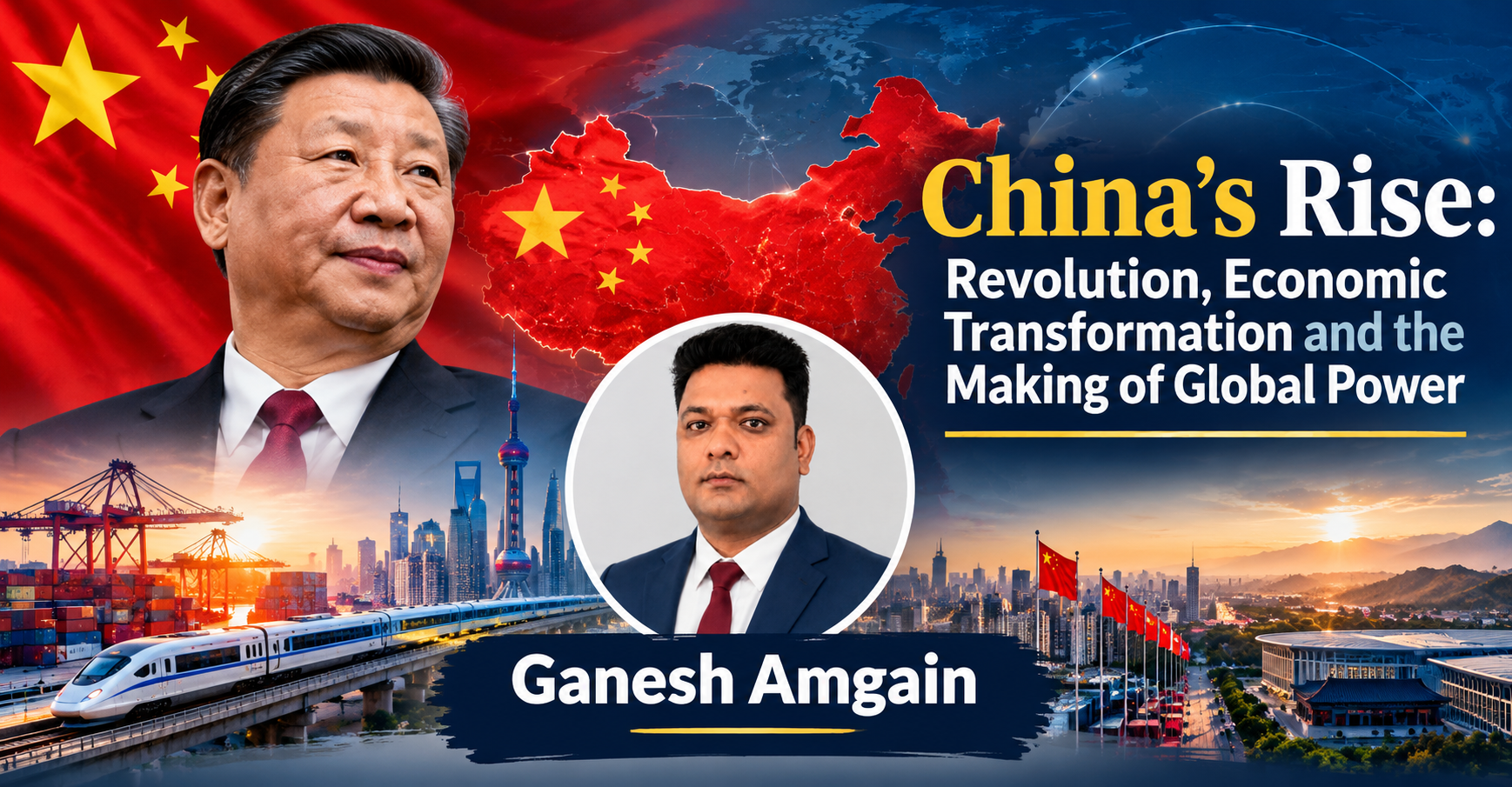
‘‘A journey spanning five millennia – from the rise of an ancient civilization and the Communist Revolution to the economic miracle and China’s evolving role in global politics”
China’s transformation from one of the world’s oldest civilizations into a major global power is among the most remarkable stories in modern history. Over thousands of years, the country has experienced imperial dynasties, feudal structures, foreign invasions, internal rebellions, civil war, communist revolution and sweeping economic reforms. Its journey is not merely a story of political change; it is also a history of civilization, power, ideology, conflict and development.
Ancient China made profound contributions to world civilization through philosophy, science, technology, papermaking, printing, gunpowder and silk production. Its intellectual and technological achievements influenced societies far beyond East Asia, helping shape the course of human development.
China’s political history has been marked by the rise and fall of successive dynasties. The Qin Dynasty unified China for the first time in 221 BC, establishing the foundations of a centralized imperial state. Subsequent dynasties, including the Han, Tang, Song, Yuan, Ming and Qing, shaped the country’s political institutions, cultural identity and economic development.
However, from the nineteenth century onwards, China entered a period of profound crisis. Foreign intervention, the Opium Wars, internal rebellions and the weakening of imperial authority undermined its sovereignty and stability. The 1911 Revolution ended centuries of dynastic rule, but the establishment of a stable political order remained elusive.
The founding of the People’s Republic of China in 1949 under Mao Zedong marked another decisive turning point. Later, Deng Xiaoping’s economic reforms connected China to the global economy, transforming it into a major center of manufacturing, trade, industry and technological innovation. Under Xi Jinping, China has sought to combine economic development with national security, military modernization and an expanded international role.
By 2026, China stands at a critical juncture. Sustaining economic growth, addressing domestic inequalities and managing strategic competition with the United States and other global powers remain among its most significant challenges.
From Ancient Civilization to the End of Imperial Rule: The Rise and Fall of Dynasties
Chinese civilization is generally traced to the fertile valleys of the Yellow River and the Yangtze River. These waterways played a fundamental role in the development of agriculture, settlements, trade and complex social structures. Early Chinese communities developed farming techniques, animal husbandry, metalworking and irrigation systems. Over time, smaller political entities evolved into powerful states, competing for territory and authority. This process laid the foundations of China’s dynastic system.
In 221 BC, Qin Shi Huang, the first emperor of the Qin Dynasty, defeated rival states and unified China under a centralized imperial government. His administration introduced standardized systems of measurement, currency, writing and administration. He also initiated the consolidation of defensive walls along China’s northern frontier, laying the foundations of what later became known as the Great Wall.
Although his rule was authoritarian and often brutal, Qin Shi Huang’s political legacy was significant. He established the institutional foundations of a unified Chinese state, many aspects of which influenced subsequent dynasties.
The Qin Dynasty was followed by the Han Dynasty, a period widely recognized for political consolidation, economic expansion and cultural advancement. Trade flourished through the Silk Road, connecting China with Central Asia, West Asia and Europe. Buddhism gradually entered China, while Confucian philosophy became deeply embedded in government administration, social conduct and family values.
The Tang and Song dynasties are often regarded as golden ages of Chinese civilization. Literature, painting, philosophy, scientific knowledge, commerce and urban development flourished during these periods. China became one of the world’s most advanced centers of learning, innovation and economic activity.
In the thirteenth century, Mongol ruler Kublai Khan established the Yuan Dynasty, integrating China into the wider Mongol imperial system. The subsequent Ming Dynasty restored native Chinese rule and witnessed significant advances in agriculture, trade, architecture and maritime exploration. The naval expeditions led by Admiral Zheng He demonstrated China’s extensive maritime capabilities and international connections. The establishment of Beijing as the imperial capital in 1420 further strengthened the city’s position as the country’s political center.
The Qing Dynasty, established in 1644, was China’s final imperial dynasty. Initially, it expanded the empire’s territory and consolidated its authority over a vast population. However, by the nineteenth century, internal corruption, popular uprisings and growing foreign intervention had seriously weakened imperial rule.
The Opium Wars with Britain inflicted a severe blow on China’s sovereignty. Through a series of unequal treaties, foreign powers secured commercial privileges, territorial concessions and special rights in Chinese ports. These developments became central to what Chinese historical narratives describe as the ‘Century of Humiliation’, a period that continues to influence the country’s national identity and foreign policy.
The Xinghai Revolution of 1911 brought an end to the Qing Dynasty, and the Republic of China was formally established in 1912. Sun Yat-sen emerged as a leading figure in the movement for national renewal and modernization.
Nevertheless, the new republic struggled to establish political stability. Power struggles, regional military leaders and competing political factions weakened the central government. Japanese aggression and internal political conflict further devastated the country. These conditions created the environment in which the Communist movement expanded and eventually established a new political order.
From Communist Revolution to Economic Reform: Building Modern China
During the early twentieth century, ideas of national liberation, social equality and political transformation gained considerable momentum in China. The Chinese Communist Party (CCP) was founded in 1921. Mao Zedong and other revolutionary leaders increasingly mobilized peasants, workers and rural communities as the foundation of their political movement.
At the same time, the Nationalist Party, or Kuomintang, led by Chiang Kai-shek, sought to consolidate national authority and govern the country. Competition between these two political forces eventually developed into a prolonged struggle that shaped China’s modern history.
In 1937, Japan launched a full-scale invasion of China. Faced with the Japanese threat, Communist and Nationalist forces temporarily cooperated against the common enemy. Following Japan’s defeat in the Second World War, however, the Chinese Civil War resumed.
Ultimately, the Communist forces under Mao Zedong emerged victorious. On 1 October 1949, Mao proclaimed the establishment of the People’s Republic of China in Beijing. The Nationalist government under Chiang Kai-shek retreated to Taiwan, where it continued to operate as the Republic of China. This political division remains one of the most sensitive and consequential issues in contemporary international relations.
The new Communist government introduced sweeping political and economic changes. Land reforms, the nationalization of major industries and a centrally planned economic system were implemented to dismantle traditional structures of ownership and establish a socialist state.
Although these policies sought to promote social equality and economic transformation, several major campaigns under Mao’s leadership resulted in enormous human and economic costs.
The Great Leap Forward, launched in 1958, aimed to accelerate industrialization and agricultural production through mass mobilization and collective organization. However, unrealistic production targets, administrative failures, coercive policies and other factors contributed to a catastrophic famine, resulting in tens of millions of deaths.
In 1966, Mao initiated the Cultural Revolution, ostensibly to preserve revolutionary ideology and eliminate what he considered counter-revolutionary influences within the Communist Party and society. In practice, the campaign produced widespread political persecution and social upheaval.
Teachers, intellectuals, artists, political officials and ordinary citizens faced intimidation, violence and persecution. Educational institutions were disrupted, historical and cultural heritage was damaged, and millions of people were affected. Mao’s death in 1976 opened the way for a fundamental reassessment of China’s development strategy.
Deng Xiaoping subsequently emerged as the principal architect of China’s economic transformation. In 1978, he introduced the policy of Reform and Opening-Up, marking a decisive departure from the rigid economic policies of the Mao era.
Agricultural reforms replaced the collective farming system with arrangements that gave households greater responsibility and incentives for production. Special Economic Zones were established to attract foreign investment, encourage exports and introduce modern production techniques. Private enterprise was gradually permitted to expand, while the Communist Party retained its political monopoly.
This combination of market-oriented economic policies and one-party political leadership became a distinctive feature of China’s development model.
During the 1990s and 2000s, China emerged as a major center of global manufacturing and international trade. Its accession to the World Trade Organization in 2001 accelerated export growth, foreign investment and industrial expansion.
The 2008 Beijing Olympic Games further enhanced China’s international image and demonstrated its growing economic and organizational capabilities.
Deng’s reforms helped lift hundreds of millions of people out of extreme poverty, supported massive infrastructure development and transformed China into one of the world’s largest economies. However, rapid growth also generated new challenges, including environmental pollution, regional inequality and labour-related concerns.
The Xi Jinping Era: Centralization of Power, Security and Contemporary Politics
The political landscape of China entered a new phase when Xi Jinping became General Secretary of the Chinese Communist Party in 2012 and President of the People’s Republic of China in 2013.
Under his leadership, the government has emphasized strong central authority, national rejuvenation, long-term development and the strengthening of the Communist Party’s position across state institutions and society.
Political discipline, national security and anti-corruption measures have become central elements of governance. These policies have reinforced the party’s influence over the country’s political, administrative, economic and strategic institutions.
One of Xi’s most prominent initiatives has been the anti-corruption campaign. Investigations and disciplinary actions have targeted officials at various levels, including senior party leaders and local government administrators.
Supporters argue that the campaign has improved administrative discipline, strengthened institutional accountability and addressed entrenched corruption. Critics, however, contend that it has also facilitated the consolidation of political power and reduced the space for internal dissent.
A significant institutional change occurred in 2018, when constitutional limits on presidential terms were removed. This opened the possibility of Xi remaining in office beyond the traditional two-term arrangement. In 2022, he secured a third term as party leader, further consolidating his position.
By 2026, the Chinese political system remains firmly centered on the leadership of the Communist Party. Xi Jinping holds the country’s three most influential positions: General Secretary of the Communist Party, President of the People’s Republic and Chairman of the Central Military Commission.
Although institutions such as the National People’s Congress and the State Council perform important legislative and administrative functions, the Communist Party continues to determine the country’s overarching political direction.
The Fifth Plenum of the 20th Central Committee, scheduled for 26-29 October 2026, is particularly relevant to discussions about China’s future economic priorities, national security and long-term development strategy. Its outcomes should be assessed through the official decisions and communiqués released by the party.
Taiwan remains one of the most sensitive issues in China’s contemporary politics. Beijing considers Taiwan an integral part of China and maintains the objective of national reunification. Taiwan, however, operates under its own democratically elected government and political system.
The United States and several of its regional allies maintain various forms of political, economic and security engagement with Taiwan. This has made the Taiwan question a major source of tension in US-China relations.
Disputes in the South China Sea over maritime rights, territorial claims, military presence and regional influence also remain significant challenges for China’s foreign policy.
Strategic competition with the United States has become a defining feature of contemporary international politics. The rivalry extends beyond trade and tariffs to semiconductors, artificial intelligence, electric vehicles, telecommunications, advanced manufacturing and military capabilities.
China has increased investment in domestic research, technological innovation and industrial self-reliance to reduce its dependence on foreign technologies. At the same time, it has sought to expand its international influence through strategic cooperation with Russia, engagement with developing countries and investments across Asia, Africa and other regions.
National unity, social stability and internal security remain additional priorities for the Chinese leadership. Beijing has strengthened central oversight in Hong Kong, while its policies in Xinjiang and Tibet continue to attract international scrutiny.
The Chinese government presents these policies as necessary for national unity, security and stability. Human rights organizations and several Western governments, however, have raised concerns about political freedoms, minority rights and the treatment of local communities.
Consequently, the Xi Jinping era can be understood as a period characterized by expanding economic and technological capabilities, greater political centralization, stronger security priorities and intensifying international competition.
The Journey Towards Economic Superpower Status: Achievements, Challenges and the 2026 Outlook
China’s economic transformation is one of the most extraordinary developments in contemporary economic history.
Before 1978, the Chinese economy was largely based on state-controlled agriculture and industry. Deng Xiaoping’s reforms introduced market-oriented mechanisms, encouraged private enterprise, attracted foreign investment and promoted export-led growth.
Special Economic Zones played a particularly important role in this transformation. By offering favorable investment conditions and developing modern industrial infrastructure, they attracted international manufacturers and helped China integrate into global production networks.
Over several decades, China evolved into one of the world’s largest manufacturing economies. Its achievements in poverty reduction, infrastructure development and industrial expansion have been substantial.
Manufacturing remains a major pillar of China’s economic strength. The country has established a formidable position in textiles, electronics, machinery, steel, chemicals, automobiles and consumer goods.
A large labour force, extensive transportation networks, modern ports, industrial clusters and integrated supply chains have helped Chinese manufacturers maintain their competitiveness.
However, China’s economic ambitions now extend far beyond low-cost manufacturing. It is increasingly investing in electric vehicles, advanced batteries, solar energy, robotics, artificial intelligence and other high-technology industries.
Infrastructure development has also been central to China’s economic rise. The country has built extensive networks of high-speed railways, highways, airports, seaports and energy facilities. The expansion of modern cities and industrial corridors has further strengthened its domestic economic integration.
In 2013, Xi Jinping introduced the Belt and Road Initiative (BRI), initially presented as a framework for expanding infrastructure connectivity, trade and economic cooperation across Asia, Europe and Africa.
Through investments in roads, railways, ports, energy facilities and other infrastructure, China has sought to strengthen international trade routes and expand its economic influence.
The initiative has created new opportunities for infrastructure development in participating countries. Nevertheless, concerns regarding debt sustainability, project transparency, environmental consequences and the long-term economic returns of certain investments remain subjects of international debate.
Despite its impressive achievements, China’s economy has encountered several structural challenges during the 2020s.
The prolonged downturn in the property sector, rising local government debt, relatively weak domestic consumption and employment pressures among young people have created significant economic uncertainty.
The difficulties faced by major property developers have affected construction, financial institutions, household wealth and consumer confidence. Meanwhile, an ageing population and declining birth rates are placing additional pressure on the labour market, pension systems and long-term economic productivity.
These challenges indicate that China’s future growth cannot depend solely on industrial production and exports. Expanding domestic consumption, improving household incomes and strengthening social protection will be equally important.
In 2026, China’s economic strategy places increasing emphasis on high-quality development, technological self-reliance, industrial modernization and the expansion of domestic demand.
Following the completion of the 14th Five-Year Plan (2021-2025), China has entered the period associated with its 15th Five-Year Plan (2026-2030). Innovation, clean energy, advanced manufacturing, scientific research and strategic industries are expected to remain important priorities.
The future competitiveness of the Chinese economy will increasingly depend on its performance in artificial intelligence, semiconductors, space research, electric vehicles, renewable energy and biotechnology.
However, technological competition with the United States, trade restrictions imposed by Western countries, domestic debt and demographic pressures could constrain its development.
Because China is deeply integrated into the global economy, changes in its economic performance have consequences far beyond its borders. Developing countries such as Nepal are also affected through trade, investment, tourism, infrastructure financing and commodity markets.
Understanding both China’s economic strengths and its structural weaknesses is therefore essential to understanding the contemporary global economic and political order.
Nepal-China Relations: History, Diplomacy and Economic Cooperation
Relations between Nepal and China predate the establishment of formal diplomatic ties by many centuries. Although the Himalayan mountain range separates the two countries geographically, historical trade, religious exchanges, cultural interactions and people-to-people contacts have connected their societies.
Historical figures such as the Buddhist scholar Buddhabhadra, the seventh-century Nepali princess Bhrikuti and the thirteenth-century artist Araniko played important roles in strengthening cultural links between Nepal and Tibet and the wider Chinese civilizational sphere.
Buddhist philosophy, artistic traditions, architecture and religious exchanges created a foundation of cultural understanding that continues to influence Nepal-China relations.
Formal diplomatic relations between Nepal and the People’s Republic of China were established on 1 August 1955. Since then, the two countries have generally based their relationship on the principles of sovereignty, territorial integrity, mutual respect and non-interference in internal affairs.
In 1960, Prime Minister Bishweshwar Prasad Koirala’s engagement with Chinese leadership helped advance bilateral relations, including discussions concerning the management of the Himalayan border. A formal boundary treaty followed in 1961.
Diplomatic engagement between King Mahendra and Chinese Premier Zhou Enlai also played an important role in consolidating relations and strengthening mutual confidence.
The question of Tibet has historically been one of the most sensitive aspects of Nepal-China relations. Political developments in Tibet have direct implications for Nepal’s northern border, security environment, cross-border trade and communities living in Himalayan regions.
Nepal recognizes the One-China principle and has consistently maintained that its territory will not be used for activities directed against China. China, in turn, has expressed support for Nepal’s sovereignty, territorial integrity and independent development.
This mutual sensitivity makes trust, diplomatic communication and respect for each other’s core interests essential to maintaining stable bilateral relations.
A significant development occurred in 2016, when Prime Minister KP Sharma Oli visited China and the two countries reached agreements on transit and transportation cooperation.
The arrangements allowing Nepal access to Chinese ports for third-country trade were widely viewed as an important step towards diversifying Nepal’s external trade routes and reducing its dependence on a single transit corridor.
In 2017, Nepal signed a Memorandum of Understanding on cooperation under China’s Belt and Road Initiative. The framework aimed to promote cooperation in roads, railways, energy, trade and people-to-people connectivity.
However, despite the diplomatic significance of the agreement, implementation of several anticipated infrastructure projects has progressed more slowly than initially expected.
High-level exchanges in 2018 and 2019 further expanded cooperation in infrastructure, tourism, energy and trade.
During Prime Minister Pushpa Kamal Dahal’s visit to China in 2023, the two countries discussed cooperation in trade, transportation and other areas of mutual interest.
In December 2024, Prime Minister Oli’s visit to China resulted in a broader framework for advancing Belt and Road cooperation. Potential infrastructure projects, including the Tokha-Chhahare Tunnel and the Hilsa-Simikot road, featured in discussions concerning future cooperation.
In 2025, Nepal and China marked the 70th anniversary of the establishment of diplomatic relations, reflecting seven decades of formal bilateral engagement.
By 2026, Nepal-China relations have entered another phase shaped by changing domestic political circumstances, regional developments and evolving economic priorities.
The two countries continue to emphasize cooperation in infrastructure, border management, energy, trade, agriculture, technology, tourism and investment.
Nepal has reiterated its commitment to the One-China principle, while China has expressed its willingness to support Nepal’s sovereignty and economic development priorities. The practical value of these commitments will ultimately depend on the progress of mutually beneficial projects and sustained diplomatic engagement.
From an economic perspective, China is one of Nepal’s most important trading partners and a significant source of foreign investment and development assistance.
Chinese engagement in Nepal extends across hydropower, tourism, industry, roads, healthcare and education. Nevertheless, the trade imbalance between the two countries remains a major concern. Nepal imports considerably more from China than it exports to the Chinese market.
Improving the operation of border points such as Rasuwagadhi and Tatopani, advancing the feasibility of cross-border railway connectivity, promoting tourism and expanding market access for Nepali products should therefore remain important priorities.
Nepal must approach its relationship with China through the lens of national interest, economic development and an independent foreign policy, rather than treating it as a strategic instrument against any other country.
For a geographically sensitive country situated between two major neighbors, balanced diplomacy, economic diversification and the protection of national sovereignty are essential.
Conclusion
China’s five-thousand-year journey reflects the extraordinary evolution of a civilization through imperial expansion, political upheaval, revolutionary transformation and economic modernization.
Today, China is not merely an economic and military power; it is also one of the most influential actors shaping the direction of global politics and the international economic system.
Under Xi Jinping, the country has prioritized national security, technological self-reliance, military modernization and the expansion of its international influence. Yet economic uncertainty, demographic pressures, internal structural challenges and intensifying competition with major powers will make its future trajectory increasingly complex.
For Nepal, China’s rise represents both an opportunity and a challenge.
Its growing economic capabilities, technological advancements and international connectivity initiatives offer potential opportunities for infrastructure development, trade expansion, tourism, energy cooperation and investment. At the same time, Nepal must carefully navigate the geopolitical sensitivities arising from its strategic location between China and India and its engagement with the wider international community.
Nepal’s foreign policy should therefore remain guided by national interest, sovereignty, economic pragmatism and balanced international relations.
The most important lesson Nepal can draw from China’s historical transformation is that sustainable national development requires long-term planning, political stability, institutional capacity, technological advancement and economic self-reliance.
China’s journey from an ancient civilization to a global power demonstrates how a country’s historical legacy, political choices and development strategies can reshape its position in the world. For Nepal, understanding this transformation is not simply an academic exercise; it is an important foundation for making informed decisions about its own future.
Publish Date: October 30, 2026








Feedback