
Understanding the internal discontent simmering in France requires looking far beyond simple public anger against the government. Beneath the surface lie multiple layers of economic inequality, a soaring cost of living, social fragmentation, eroding trust in political representation, debates over immigration, labor rights, and deep dissatisfaction with the state’s decision-making processes. Compounding these domestic grievances are broader European security challenges, shifting Russia-West relations, global economic competition, and the rapid spread of misinformation across social media.
However, a crucial distinction must be made: genuine public discontent and the forces seeking to exploit it for narrow political gain are not the same thing. While external actors may attempt to capitalize on a nation’s vulnerabilities, such opportunistic moves do not automatically mean an entire movement was orchestrated by foreign conspiracy. Substantiating such claims requires concrete proof.
Comparing the unfolding developments in France to the 2011 Arab Spring demands similar caution. While both contexts highlight the critical importance of public trust, economic opportunity, political accountability, and state responsiveness, their underlying governance systems, civil liberties, institutional structures, and movement objectives differ significantly. Consequently, evaluating the potential ripple effects of the French crisis across Western democracies – and extracting liquidation-free lessons for nations like Nepal – requires a grounded analysis of facts, history and prospective futures.
Roots of Discontent: Economic Pain and Political Distrust
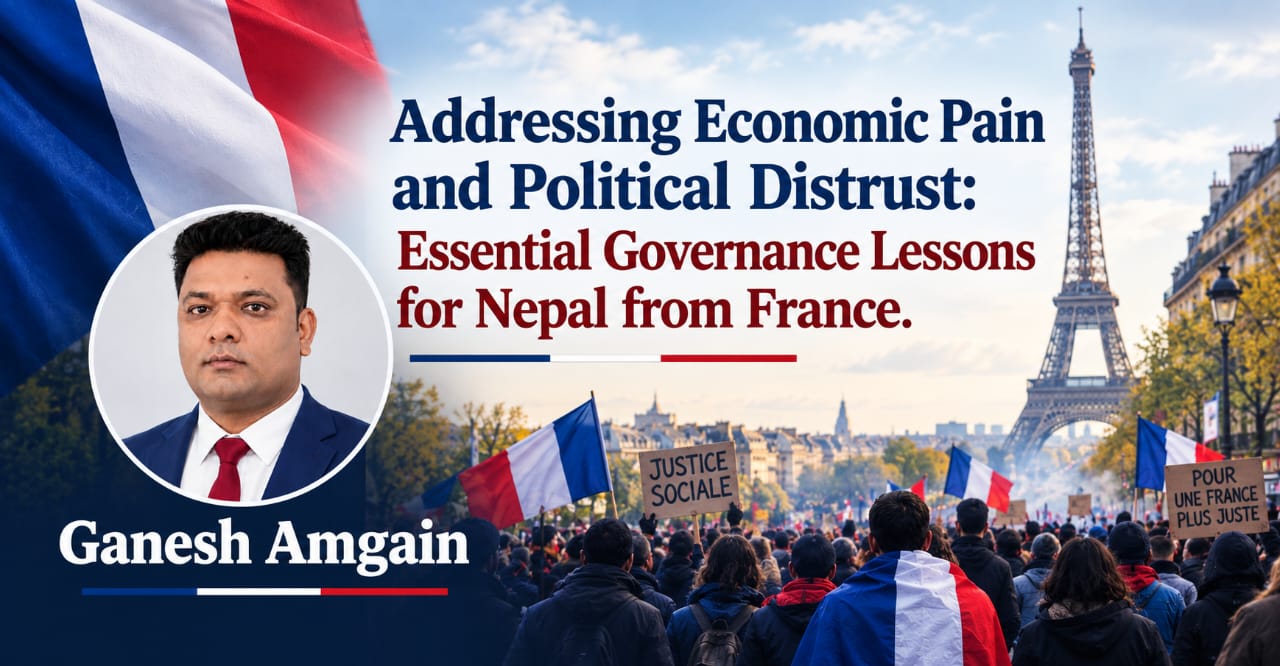
The protests that escalated in France beginning in September 2026 initially sparked over decaying school infrastructure, severe teacher shortages, and crumbling public services. Over time, this discontent broadened into a fierce backlash against inflation, widening inequality, inadequate public spending, and the government’s broader economic policies. On October 17, protests turned violent with incidents of vandalism and looting, intensifying pressure on the administration. Massive turnouts flooded streets nationwide on October 24; while government officials estimated the crowd at 410,000, labor unions claimed participation was more than double that figure, highlighting stark discrepancies in how the scale of the movement is interpreted.
Economic Crisis and Cost of Living: A large national economy does not automatically translate to ease of living for every citizen. When the costs of rent, food, energy, transport, and daily necessities surge faster than personal incomes, household frustration mounts. When young people lose hope of securing stable employment after completing their education, a deep-seated pessimism regarding the future takes root. Compounding this, when the quality of public schools, hospitals, and local services visibly deteriorates, citizens feel the state has abdicated its core responsibilities. Dismissing street-level anger as the work of isolated rabble-rousers ignores these deeply intertwined socioeconomic grievances.
Eroding Political Representation: When citizens feel their voices are consistently ignored in decision-making processes despite casting ballots, faith in democratic institutions wanes. In France, the centralization of presidential power, controversial economic reforms, debates over public expenditure cuts, and intense political polarization have amplified these doubts. While government supporters argue that fiscal discipline and financial stability are imperative, critics counter that the heavy burden of spending cuts falls disproportionately on ordinary citizens. When political leaders fail to bridge these opposing viewpoints, routine policy disagreements quickly transform into sweeping political crises.
State Behavior and Security: Peaceful protest is a foundational democratic right, but arson, looting, the destruction of public property, and violence against individuals do not fall under that umbrella. While the state bears the responsibility of maintaining public order, the use of force by security agencies must be strictly necessary and proportionate. If demonstrators feel entirely locked out of dialogue or perceive that authorities treat all critics like criminals, hostility escalates. Conversely, conflating violent actions with legitimate political dissent risks drowning out the voices of peaceful protesters. Striking a delicate balance between safeguarding civil liberties and ensuring public safety remains France’s paramount challenge.
Political Competition and Fiscal Realities: With upcoming presidential elections on the horizon, various political factions view public frustration as an opportunity to rally support for their platforms. Right-wing factions emphasize public safety and immigration control, whereas left-wing groups campaign heavily for increased investments in wages, pensions, education, healthcare, and public services. Meanwhile, centrist forces champion fiscal discipline and economic stability. While these competing visions are valid components of democratic competition, opportunistic attempts by any single party to steer a movement do not prove that party engineered it from the start. The legitimacy of public demands, grassroots leadership, and partisan exploitation must be analyzed independently.
External Geopolitics: Interference vs. Exploitation
Jumping to conclusions by labeling the French protests a foreign conspiracy outpaces available evidence. At the same time, dismissing the possibility that external powers might exploit another nation’s political instability for strategic gain would be deeply naive. Three distinct questions must be addressed: Who originally sparked the movement? Who sought to profit from it as it expanded? And who weaponized the narrative surrounding the protests to serve foreign political objectives?
Publicly available investigations and statements from European officials indicate that definitive proof linking the genesis of the protests to foreign actors has yet to surface. However, mounting concerns persist regarding how foreign information networks have manipulated the narrative to advance their own agendas. Exploiting internal domestic vulnerabilities is a time-tested strategy in geopolitical competition. When public trust in a government declines, hostile external actors readily amplify messaging designed to portray national leadership as incompetent.
Furthermore, nations providing heavy financial or military assistance to foreign conflicts often face targeted domestic disinformation campaigns linking those external expenditures to domestic inflation. As an influential member of the European Union and NATO, and a key partner in Western policy supporting Ukraine, France’s political vulnerabilities naturally threaten to complicate European consensus, Russia policy, and allied unity. Yet, acknowledging this susceptibility is entirely different from proving that a foreign government manufactured the unrest.
Information Warfare and Disinformation: Social media campaigns frequently recycle footage from older events to pass them off as current crises, magnify unverified allegations, or present isolated violent incidents as representative of an entire society. Weaving legitimate economic grievances into distorted, hyperbolic narratives fuels societal paranoia. While investigations into the October protests found no evidence that foreign networks originated the unrest, they did conclude that pro-Russian information operations actively amplified and sensationalized the violence to discredit Western policies on Ukraine. Such findings highlight ongoing hybrid threats, though individual allegations must always be treated as analytical insights rather than judicial verdicts.
Implications for European Unity: At stake is the future stability of the European Union itself. Persistent political instability in an influential member state like France threatens to paralyze EU decision-making. Consensus on defense spending, energy security, trade, migration, and assistance to Ukraine risks fracturing. Rival powers like Russia stand to reap diplomatic dividends from such paralysis. Nevertheless, European nations possess diverse national interests and distinct domestic pressures, meaning that reducing France’s complex internal discontent to a mere puppet show orchestrated by a single foreign power oversimplifies geopolitical reality.
A European Arab Spring? Understanding Spread and Structure
Drawing parallels between the 2011 Arab Spring and contemporary French protests highlights shared themes of public grievance and accountability deficit, but treating them as identical phenomena is misleading. The Arab Spring erupted out of profound desperation in Tunisia in late 2010 before sweeping across Egypt, Libya, Yemen, and Syria – fueled by chronic unemployment, systemic corruption, a lack of economic opportunity, political repression, and entrenched autocracy. While digital media accelerated the spread of those uprisings, their outcomes varied drastically, ranging from regime change and civil war to the resurgence of old authoritarian structures.
Institutional Resilience vs. Fragility: France shares common triggers with past uprisings – inflation, social inequality, weakening public services, and political alienation. However, unlike fragile states, France possesses resilient institutional safeguards, including regular elections, established judicial structures, independent media, and organized labor federations. Citizens retain legal mechanisms to challenge policies, vote out leaders, and voice dissent. Consequently, the French crisis does not threaten immediate systemic collapse. Nonetheless, if public faith in these institutions continues to erode, political compromise stalls, and the state repeatedly ignores social demands, the crisis could deepen significantly.
Wider European Discontent: Discontent is manifesting in diverse forms across neighboring European countries. Belgium has witnessed student-led demonstrations protesting government spending cuts. Italy is grappling with vocal opposition over soaring energy costs, fuel prices, and school conditions. Spain faces severe housing and rental shortages alongside mounting pension and labor disputes, while Portugal is gripped by a youth housing crisis, escalating rents, and depressed wages. While these widespread demonstrations reflect a shared European cost-of-living squeeze, there is no evidence suggesting they are centrally coordinated or share a unified political objective.
Key Lessons for Nepal: Proactive Governance vs. Reactive Crisis
The events in France offer vital lessons for countries like Nepal, starting with the imperative that public discontent must never be evaluated solely through the lens of street crowds. When youth participation surges, students protest academic conditions, or workers initiate strikes, genuine systemic pressures are almost always at play. Unemployment, inflation, frustration with corruption, deteriorating public services, and unequal access to opportunity easily breed profound disillusionment. In Nepal, young citizens continuously search for respectful domestic employment, quality education, fair competition, and confidence in the future. Rather than reacting only after protests boil over, governments must institutionalize regular public dialogue, open hearings, and independent research to identify underlying grievances early. Listening to public complaints is not a sign of weakness; it is the most effective tool for preventing major political crises.
Linking Macro Growth to Everyday Realities: High national GDP growth, expanding road networks, and mega-infrastructure projects represent important milestones. However, if ordinary families struggle to afford basic food, rent, education, healthcare, and transportation, the psychological impact of development evaporates. When educated youth spend years studying only to find stagnant job markets or misaligned employment opportunities, despair sets in. Nepal must therefore measure economic success not just through macro growth indicators, but by tracking real wages, job quality, household expenditure burdens, regional equity, and public service accessibility. Governance priorities must remain anchored in tangible improvements to everyday life.
Demanding Accountability and Transparency: Winning an election in a democracy does not grant a blank check to ignore public suffering. Elected representatives must transparently justify policy decisions, account for public expenditures, and shoulder responsibility for policy failures. Prolonged cycles of partisan bickering devoid of substantive progress in education, healthcare, employment, and good governance inevitably breed public cynicism. Strengthening parliamentary debate, empowering oversight committees, ensuring independent auditing, and rigorously enforcing the Right to Information and anti-corruption measures are essential. Changing governments without reforming governance styles, decision transparency, and civic responsiveness resolves nothing.
Proportionate Crowd Control and Legal Balance: Citizens retain the fundamental right to peaceful assembly, free expression, and lawful dissent. Governments must never use national security as a blanket pretext to criminalize all criticism. Simultaneously, protesters have no right to engage in arson, looting, vandalism, or violence against fellow citizens. Security agencies in Nepal must enforce necessary, proportionate crowd control protocols, ensure prompt medical care for the injured, and conduct impartial investigations into any human rights abuses. Establishing clear channels of communication between protest organizers and state authorities helps preserve both state legitimacy and civic rights.
Countering Misinformation Responsibly: As demonstrated in France, social media platforms can easily warp legitimate grievances into weaponized narratives driven by external interests or partisan propaganda. Similar vulnerabilities exist in Nepal, where recycled historical footage, unverified allegations, and incendiary identity-based or regional polarization material can rapidly spread. The antidote to disinformation is not shutting down digital platforms or labeling critics as foreign agents. Instead, government institutions must release factual information transparently and promptly, media outlets must rigorously verify their sources, and citizens must exercise digital literacy before sharing content. Validating foreign interference claims requires verifiable, evidence-based investigations – never using external bogeymen to sweep domestic administrative failures under the rug.
Conclusion: Signals for Global Governance
The current unrest in France is fundamentally rooted in internal economic, social, and political friction. While foreign actors may attempt to exploit these tensions through targeted information campaigns, concrete public proof confirming that the movement was engineered by a foreign conspiracy remains absent. Across Europe, parallel protests over inflation, housing shortages, education, and public services reflect shared socioeconomic pressures rather than a coordinated global revolution.
When contrasted with the 2011 Arab Spring, the core parallels lie in public frustration and the demand for political accountability, though institutional capacities and governance structures differ markedly. The trajectory of France will ultimately depend on how effectively its government listens to public demands, addresses economic hardships, and preserves the delicate equilibrium between civil liberties and public security.
For Nepal, the message is unmistakable: public dissent must not be treated as hostility, but rather as an early diagnostic signal for governance reform. Public trust is never earned through political rhetoric; it is forged exclusively through equitable opportunity, institutional transparency, and visible, tangible results.
Publish Date: October 28, 2026







Feedback