
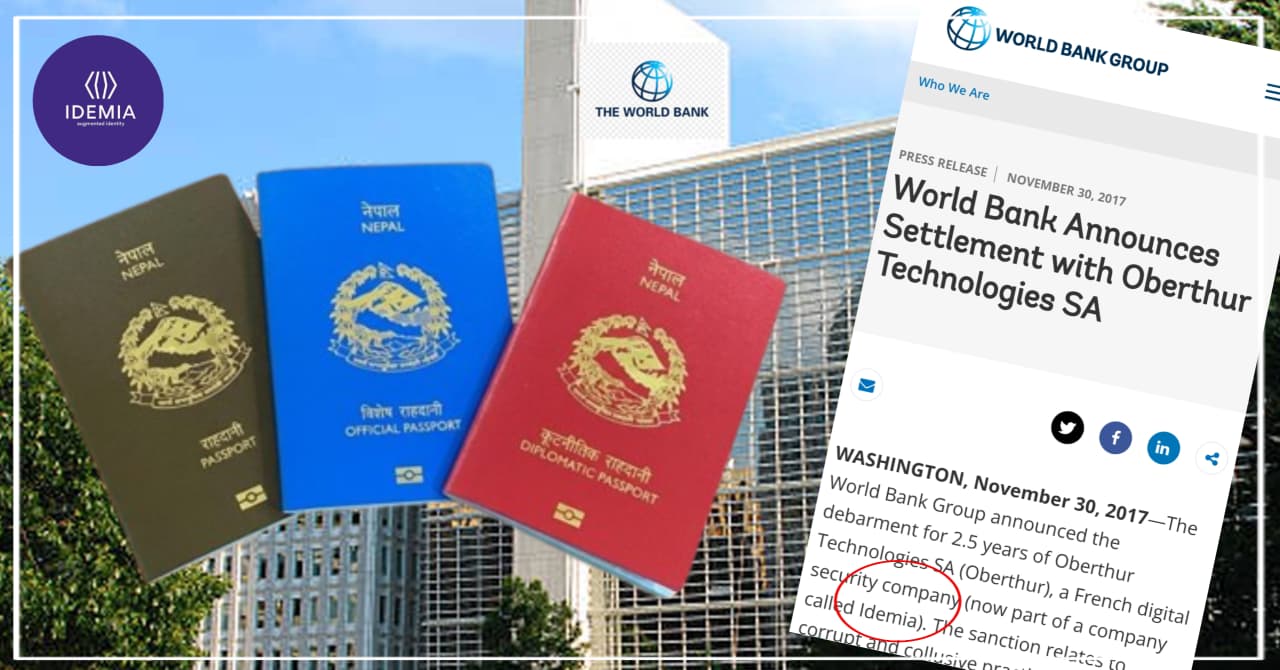
Kathmandu — A French company that handled Nepal’s passport printing for nearly 16 years has come under renewed scrutiny after international records confirmed that it had been debarred by the World Bank over corruption-related findings, prompting fresh questions over why successive governments continued awarding it contracts for one of the country’s most sensitive security documents.
According to publicly available records, the World Bank debarred IDEMIA (formerly Oberthur Technologies) in 2017 after determining that the company had engaged in corrupt practices in connection with Bangladesh’s National Identification System project. The company was barred from participating in World Bank-financed projects after admitting to anti-competitive collusion during the bidding process and making improper payments to an agent.
Questions have also been raised over Nepal’s passport procurement process, with reports alleging that competition was similarly restricted and that payments to the company’s Nepali representative, Siddhartha Pandey, were made abroad in a manner allegedly inconsistent with Nepal’s prevailing laws.
Despite the company’s internationally controversial record, IDEMIA continued to secure Nepal’s highly sensitive passport printing contracts for nearly one and a half decades. During that period, repeated contract variations reportedly increased project costs significantly, placing an additional financial burden of billions of rupees on the state.
The issue has gained renewed attention following the recent award of Nepal’s new e-passport printing contract to German state-backed company Veridos, which submitted a substantially lower bid. Reports previously surfaced alleging attempts to cancel the competitively awarded contract and restore the passport printing work to the former French contractor.
According to sources cited in the reports, Siddhartha Pandey, identified as IDEMIA‘s representative in Nepal, allegedly sought to influence the procurement process through senior advisers to Prime Minister Balen Shah, including Kumar Byanjankar and Asim Shah, by exerting pressure through the Office of the Prime Minister and Council of Ministers on the Ministry of Foreign Affairs. However, the attempt was reportedly unsuccessful after Foreign Minister Shishir Khanal refused to cancel the competitively awarded contract with the lower-priced bidder.
The controversy has triggered broader questions over how a company later debarred by the World Bank over corruption-related findings continued to receive Nepal’s passport printing contracts for approximately 16 years. It has also prompted scrutiny of decisions made by successive governments, ministers, secretaries, department heads, and other senior officials who approved those contracts.
Observers are increasingly questioning whether those procurement decisions were made solely in the public interest or were influenced by vested interests. Critics have also argued that, instead of thoroughly examining the past role of an internationally controversial contractor, efforts were allegedly directed toward challenging the competitively awarded contract secured by Germany’s Veridos, raising fresh concerns over transparency, public procurement practices, and governance in Nepal’s passport procurement system.
Publish Date: July 6, 2026









Feedback