
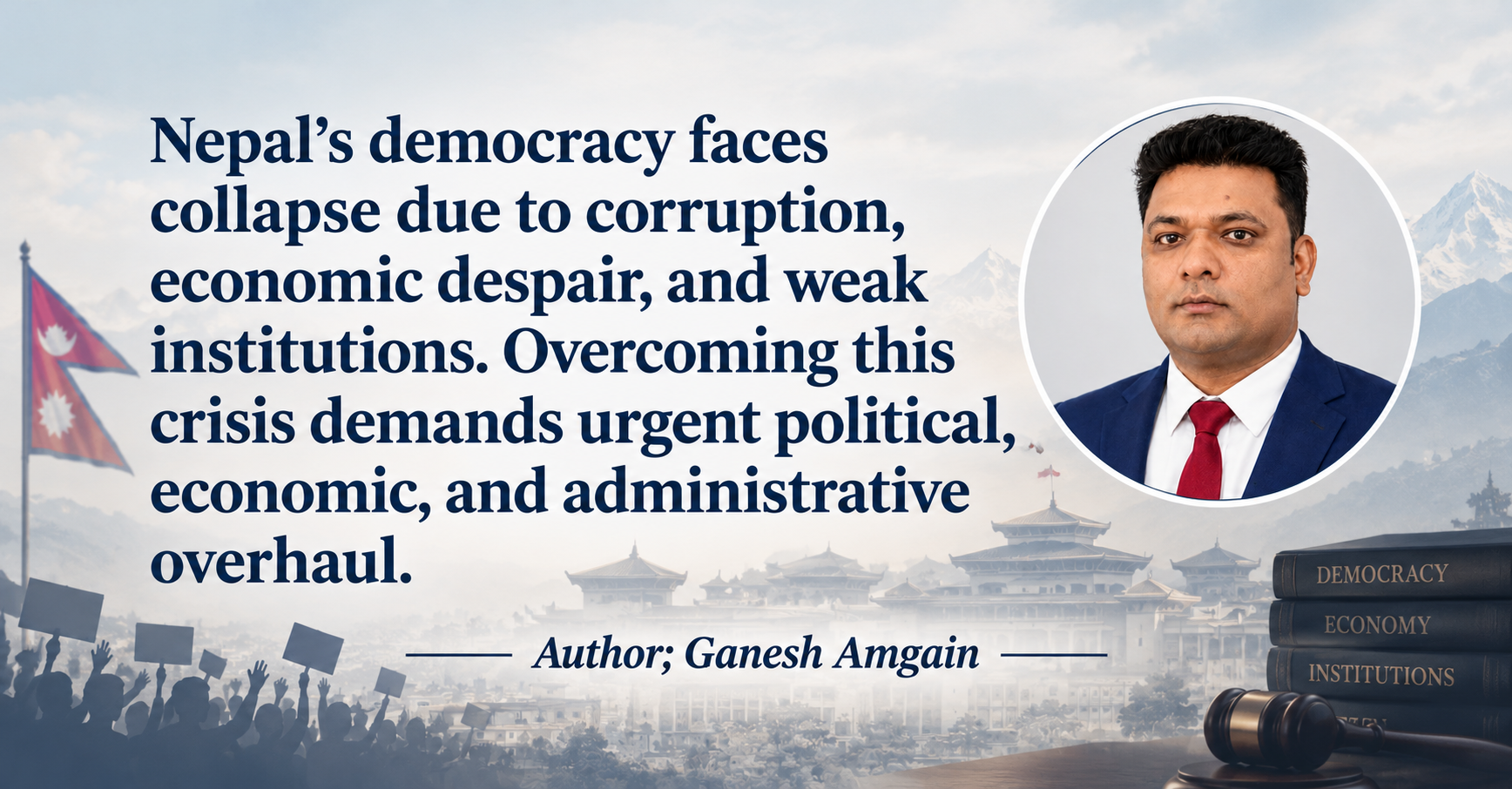
The widespread frustration, discontent, and restlessness witnessed across Nepal’s political and social landscape are neither sudden accidental occurrences nor superficial failures. Rather, they are the outcome of a long-term crisis born from predatory governance methods, the internal working styles of political parties, structural weaknesses within the economy, and an absolute neglect of good governance. Strengthening Nepal’s democratic system and governance framework requires a profound and critical review of both theoretical and practical flaws within the state – an imperative historical necessity today.
A governance system that operates by mocking the rule of law has failed to bring any positive transformation to the lives of ordinary citizens, thereby eroding public trust day by day in a system that merely wears the mask of democracy. Unless the state guarantees citizens’ basic livelihoods, social justice, and economic security, even the most celebrated constitutions and paper systems will fail to ignite hope among the people. Failing to timely analyze and seek proper solutions for these multidimensional distortions across political, economic, social, legal, and geopolitical spheres will inevitably pose severe question marks over national sovereignty and systemic stability.
Political Fragility and the Absence of Good Governance
Political fragility, dissent, and public discontent emerge from deeply entrenched systemic flaws within the nation’s political and social order. The tendency among leaders to prioritize personal and partisan interests over public service has institutionalized widespread corruption and irregularities across all tiers and organs of the state. Such political maneuvering, driven by narrow partisan interests, has constantly sidelined national priorities and left the country directionless.
The state has been severely weakened by policy inconsistencies, where governments and public representatives remain unaccountable to the public, transparency is entirely absent, and any change in government leads to the politically motivated cancellation of preceding administrations’ sound policies and plans. Public frustration has reached extreme heights due to administrative delays, bribery, harassment in service delivery, and rampant nepotism and cronyism that favor close associates over merit.
The unbridled exploitation of state resources and abuse of public office have left ordinary citizens thoroughly disillusioned, while an entrenched political culture of making grand election promises only to trample upon public rights afterward has become the state’s defining characteristic. Furthermore, a pervasive culture of impunity – where perpetrators of crime and corruption are shielded through political protection – makes a mockery of the rule of law.
Public faith in the state has hit rock bottom due to a lack of visionary leadership that focuses on immediate political gains rather than long-term development, coupled with intense political interference and power-sharing in independent constitutional bodies like the Commission for the Investigation of Abuse of Authority (CIAA) and the Election Commission. Ordinary citizens feel that justice is dying due to continuous political meddling in the independent judiciary and security apparatus, breeding societal anarchy that serves as a primary driver compelling the youth to leave the country.
Regular violations of parliamentary dignity, frequent disruptions, and the demise of policy-based politics in favor of a mere game for power have thoroughly crippled Nepal’s political system. The rampant use of excessive campaign funds and black money has virtually barred honest and capable individuals from entering politics while expanding the grip of mafias over parliament. Against this backdrop, rulers sustained by citizen taxes remain engrossed in luxurious lifestyles instead of sharing the struggles of the people, daily fueling public outrage. Therefore, ensuring political stability requires uprooting the partisan syndicate, power-sharing politics, and the culture of impunity through genuine internal party democracy and strict accountability.
Economic Despair and Systemic Collapse
A political system devoid of economic prosperity is like a castle built on sand, vulnerable to collapse at any moment. Unless citizens secured employment and economic stability, even the finest constitution cannot survive. A severe decline in economic activity and revenue collection has created a dire situation where the government struggles merely to run daily state operations. While budget shortages have crippled public service delivery in education, health, and transport, the inability to disburse timely salaries to civil servants and security personnel erodes their loyalty toward the state apparatus.
Capital expenditures for infrastructure development have dropped to near zero due to economic scarcity, bringing developmental momentum to a complete standstill. With weak internal revenue, the country is sinking deeper into a quagmire of foreign debt, steering toward a bankruptcy risk where it cannot service loan installments. Depleted foreign exchange reserves prevent the import of essential fuel, medicine, and food grains, triggering monetary instability and hyperinflation. Rampant black-market operations, artificial shortages, and the dominance of middlemen have skyrocketed the prices of daily essentials, bearing heavily on the working class and the poor.
Amid widespread unemployment, millions of youths are forced to migrate to the Gulf and Western nations, leaving the domestic productive force and youth energy exposed to exploitation in political unrest or extremist activities. The persistent neglect of the agricultural sector, shortages of fertilizers and irrigation, closing domestic manufacturing industries, expanding trade deficits, and soaring interest rates in the banking sector have rendered daily survival grueling for small business owners and farmers alike. The agony of youths forced to carry passports because they find no environment to sweat in their own country has pushed the nation’s demographic dividend into a grave crisis.
Seizing this economic downturn, middlemen, black-marketeers, and crony capitalists have captured policy-making tiers, rendered the overall economy dependent and debilitated. Policies crafted under the dictation of narrow corporate houses rather than public welfare have concentrated wealth in the hands of a privileged few, widening the chasm between the rich and the poor to an extent that portends severe social conflict in the future. Ultimately, this sickly state of the economy directly batters the political system, proving that without building a robust productive economy, employment-generating policies, and an investment-friendly environment, dreaming of political stability remains an illusion.
Social Fractures and Geopolitical Pressures
Beyond political and economic crises, deep-rooted social inequalities, cultural discriminations, and geopolitical pressures play a pivotal role in eroding the state’s foundations. Social harmony has been fractured by the lack of proportional representation across state machinery for all communities, castes, regions, and genders, mounting grievances among historically marginalized classes and movements framed around identity and rights. Persistent developmental disparities between accessible urban centers and remote rural areas, coupled with ineffective legal enforcement against gender-based violence and untouchability, have deepened class and ethnic chasms. These structural discriminations across various societal levels mock the very concept of a just society.
Similarly, internal decision-making processes and cabinet formations are increasingly influenced by foreign powers due to geopolitical tug-of-wars and external interference. Open border security challenges, unequal treaties, and stringent conditions attached to foreign aid severely undermine national sovereignty and independence. Occupying a sensitive strategic geography, Nepal is constantly haunted by the threat of becoming a playground for major regional and global powers. The self-respect of the nation has eroded on international platforms due to a leadership incapable of conducting diplomatic relations with national interest and sovereignty as paramount priorities.
Concurrently, with the rapid proliferation of technology, fake news, hate speech, and social media algorithms have generated intense ideological polarization, rendering society increasingly intolerant. A flood of sensational content rather than factual reporting has impaired the public’s faculty of critical thought, fostering a culture of mutual distrust toward the government, leaders, police, and judiciary. When no state institution can deliver a sense of justice or fairness, profound alienation settles deep within the citizenry, risking driving democracy and the constitutional structure into a perilous abyss.
Practical and Policy-Level Solutions
Guaranteeing administrative reform, good governance, and transparency is the primary precondition for bridging the chasm between state governance and public discontent. To completely eradicate the endless delays and culture of bribery plaguing public service delivery, government operations must transition entirely into a digital framework (E-Governance), ensuring transparency in decision-making and reducing the interference of middlemen to zero. Appointments across key state organs must be decoupled from partisan power-sharing and anchored strictly in merit, capability, and neutrality. Most importantly, constitutional bodies like the CIAA must be granted absolute autonomy, backed by the political will to bring anyone involved in corruption under the net of the law without fear or favor.
To establish administrative accountability, the ‘Right to Service’ law must be rigorously enforced, deducting financial penalties directly from the salaries of erring officials who fail to complete tasks within mandated timeframes. Furthermore, an independent Property Investigation Commission must be formed to thoroughly probe the illicit wealth of all high-ranking leaders and officeholders who have held public office since 1996, while open data policies must be mandated for public oversight and the practice of governing through unconstitutional ordinances permanently halted.
Achieving sustainable peace and stability is equally impossible without radical reforms in the political, electoral, and economic systems. Replacing the current volatile parliamentary system with a directly elected executive model (Prime Minister or President) can ensure stability, while state campaign funding or stringent legal monitoring must be enforced to curb the runaway influence of black money in elections. Advanced democratic rights – such as the ‘Right to Reject’ unfavorable candidates and the ‘Right to Recall’ non-performing lawmakers – must be constitutionally enshrined alongside legally mandated internal party democracy to shatter dynastic politics.
To rescue the economy from dependency, small, medium, and cottage industries must receive special tax exemptions, subsidized grants, and direct marketing assistance under a “Buy Indigenous” policy, supported by accessible, collateral-free technical loans for youth startups. Prioritizing agriculture requires legally guaranteed timely supplies of fertilizers, improved seeds, irrigation, and minimum support prices for farm produce, effectively curbing import-led economics to balance the trade deficit and stem youth exodus. Finally, equitable representation for marginalized communities must be guaranteed across all state organs, and fundamental rights like education and healthcare must be removed from profit-driven commerce and brought under complete state responsibility.
Institutional Autonomy and Civic Education
In developing democratic nations like Nepal, enhancing institutional capacity, upholding the doctrine of the separation of powers, enforcing the rule of law, and fostering moral education form the bedrock of good governance. Key state institutions must be fully insulated from the partisan agendas of political leaders and granted complete structural autonomy. Appointments of heads and officials to sensitive bodies like the CIAA, Election Commission, Public Service Commission, and the judiciary must be constitutionally guaranteed based on open competition, high moral character, and expertise rather than partisan quotas.
These institutions must be financially empowered with independent budget-management rights, freeing them from dependency on the Ministry of Finance so they can discharge their duties with absolute impartiality. To uphold checks and balances, the Supreme Court must firmly halt executive overreach through ordinances, parliamentary thematic committees must be empowered with binding oversight authority, and opposition parties should institutionalize a ‘Shadow Cabinet’. To purify the judiciary, judge appointments through the Judicial Council must be transparent, and a 100% automated court docket system implemented in the Supreme Court to eliminate case-fixing.
Regarding the rule of law, the principle that “everyone is equal before the law” must be visibly demonstrated, dismantling the culture where the powerful escape accountability. Fast-track courts should be established to resolve cases of corruption, heinous crimes, and human rights abuses within six months, while police investigations must be insulated from political pressure by structurally separating investigative and prosecuting agencies. Simultaneously, ordinary citizens must earnestly grasp their duties toward the nation – including paying taxes, protecting public property, obeying traffic regulations, and rejecting candidate inducements during elections to displace shortsighted leadership.
To nurture responsible citizens for the future, practical, moral, and legal education must be seamlessly integrated into school curricula. Primary levels (Grades 1–5) should cultivate habits of morality, etiquette, personal hygiene, and dignity of labor, while lower secondary levels introduce constitutional knowledge, civic duties, financial literacy, and digital safety. Secondary education must enforce legal literacy, critical thinking, entrepreneurship, and mandatory community service, ensuring that through visionary systemic reforms and educational transformation, a well-governed, prosperous, and just nation can be built.
Publish Date: October 13, 2026






Feedback