
The unceasing coexistence between primitive nature and human civilization serves as the true cornerstone of sustainable development. In the contemporary global context, the right to development and environmental rights are no longer viewed through isolated lenses; rather, they are recognized as third-generation “collective or solidarity rights.” The United Nations Declaration on the Right to Development (1986) institutionalized development as an inalienable human right. Similarly, the 1972 Stockholm Declaration, the 1992 Rio Declaration, and the historic 2022 UN General Assembly resolution established the “right to a clean, healthy, and sustainable environment” as a universal human right.
For a landlocked, highly vulnerable, and risk-prone mountainous nation like Nepal, achieving rapid economic prosperity while safeguarding the environment presents a dual challenge. Although Article 30 of the Constitution of Nepal guarantees the “right to a clean environment” as a fundamental right, practical realities reflect an inadequate balance between infrastructure development and the exploitation of natural resources. Human-centric development dictates that citizens should not merely be passive consumers of development outcomes, but active drivers, decision-makers, and stakeholders in its implementation. True sustainability can only be realized through development that avoids environmental degradation.
Embracing the core essence of “sustainable development” – meeting the needs of the present without compromising the inherent rights of future generations – has become an urgent imperative. Protecting biodiversity, controlling pollution, and ensuring the judicious utilization of natural resources to safeguard public health and societal well-being are paramount state responsibilities. If natural cycles and ecosystems are decimated in the reckless pursuit of higher economic growth rates, the resulting catastrophes will prove far more costly than any short-term developmental gains. Consequently, keeping the interdependent relationship between rights and duties in mind, Nepal must decisively transition toward a green economy without delay.
Environmental Justice and Governing Principles
In the international arena, several foundational principles have been established regarding the deep interconnectedness between environmental rights and human rights. Chief among these is the Precautionary Principle, which dictates that where there are threats of serious or irreversible damage, a lack of full scientific certainty shall not be used as a reason for postponing protective measures. Environmental Impact Assessments (EIAs) must be made mandatory and effective, ensuring an objective analysis of environmental and social risks prior to launching large infrastructure or industrial projects.
Similarly, the Polluter Pays Principle places the legal and financial burden of environmental restoration and victim compensation directly on the polluting industry, organization, or individual. For countries like Nepal – whose contribution to global greenhouse gas emissions is negligible (0.09%), yet bears the brunt of climate change impacts – the right to Climate Justice becomes critical. This right demands special protection and compensation for poor, developing, and marginalized communities most severely affected by climate shocks.
Furthermore, the principle of Intergenerational Equity reminds us that future generations possess an equal right to a safe environment as the present generation. States and their citizens maintain sovereign rights over the water, land, forests, and minerals within their geographical boundaries. In tandem, the 1998 Aarhus Convention prioritizes access to environmental information, public participation in decision-making, and access to justice in environmental matters.
The UNFCCC and the Paris Agreement emphasize limiting global temperature rise to 1.5°C, reducing greenhouse gas emissions, and mobilizing climate finance. The UN Sustainable Development Goals (SDGs) – particularly Goals 7, 8, 13, 14, and 15 – directly link clean energy, economic growth, climate action, and ecosystem protection. Poverty alleviation and environmental conservation are mutually reinforcing; empowering citizens with skills and employment to achieve self-reliance naturally curtails the overexploitation of natural resources.
Ultimately, environmental justice advocates not only for ecological balance, but also for the survival of vulnerable and marginalized communities. Nepal must fully align its national policies with these international principles and conventions. The equitable distribution of benefits derived from natural resources and the shared management of environmental risks constitute the true test of environmental justice.
Nepal’s Geographical and Ecological Challenges
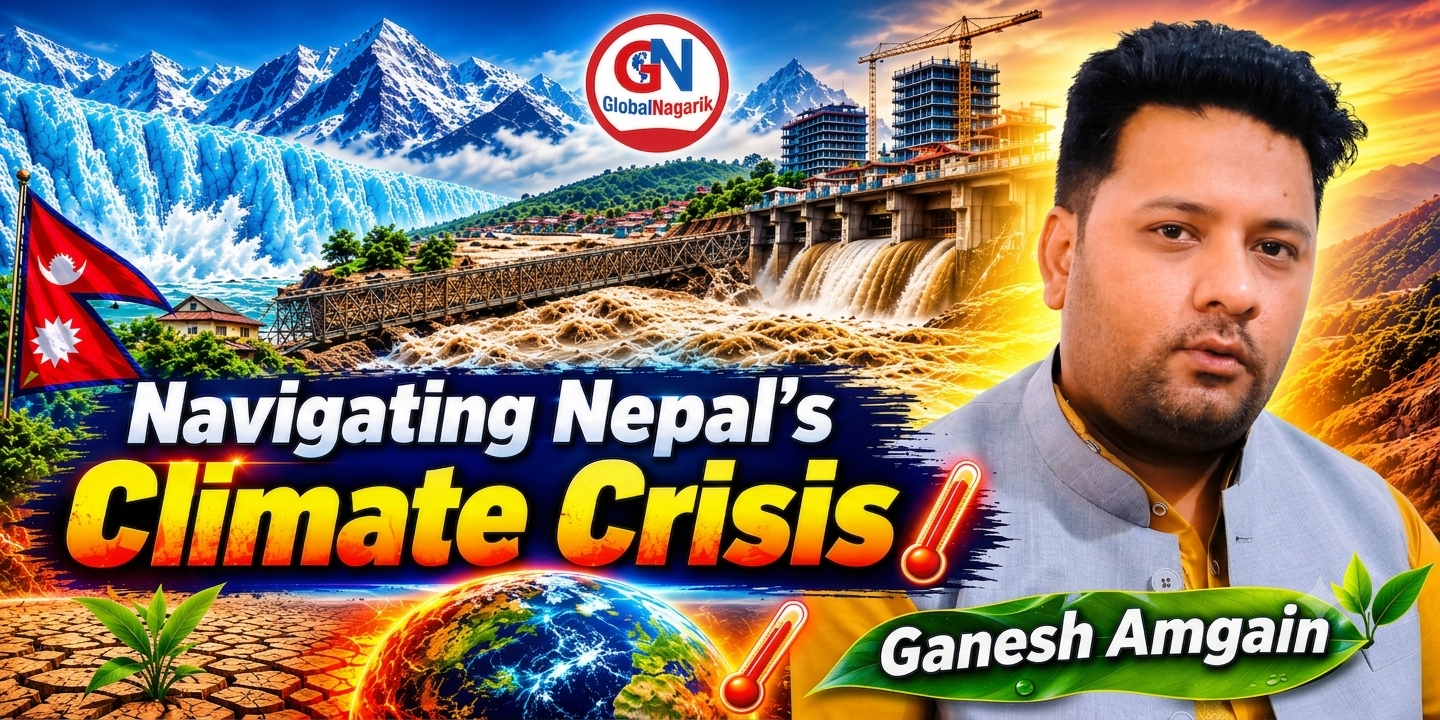
Nepal currently stands at the perilous intersection of a Triple Planetary Crisis: climate change, biodiversity loss, and pollution. Accelerated warming in the Himalayan region has led to rapid glacial retreat and heightened the threat of Glacial Lake Outburst Floods (GLOFs). In recent years, catastrophic flooding in Melamchi and flash floods in the Bhote Koshi river have inflicted irreversible damage on downstream settlements, bridges, and hydropower projects.
In the hilly terrains, the haphazard use of heavy machinery to construct rural roads-without regard for fragile soil dynamics – has triggered severe soil erosion and massive landslides. Unpredictable monsoons characterized by extreme localized rainfall alongside prolonged dry spells have disrupted traditional agriculture and dried up natural water sources, triggering acute drinking water crises.
Unregulated and illegal extraction of riverbed materials (gravel, sand, and stone) has severely disrupted natural river hydrology. Rapid degradation of the Chure region risks turning the fertile Terai-Madhesh plains into arid landscapes. Simultaneously, unplanned urbanization encroaches upon natural drainage systems, exacerbating urban flooding alongside severe plastic and solid waste management crises.
These environmental disasters do more than inflict physical damage; they create vast numbers of “climate refugees.” Uncontrolled migration from the hills to the Terai and urban centers threatens demographic stability. The loss of biodiversity, depletion of valuable medicinal herbs, rising frequency of forest fires, and intensifying human-wildlife conflicts add to Nepal’s growing environmental predicament.
Failure to enforce environmental standards and EIAs during infrastructure development, the absence of robust early warning systems, and poor coordination among the three tiers of government further complicate the crisis. Billions of rupees invested in hydropower projects remain vulnerable to floods and landslides. Striking a balance between the urge for rapid development and the escalating risks of natural disasters remains Nepal’s defining challenge.
The Imperative of Aggressive Climate Diplomacy
Because the primary driver of the climate disasters facing Nepal is global carbon emissions, internal efforts alone are insufficient; Nepal must execute an aggressive and proactive climate diplomacy strategy. At UN Climate Change Conferences (COPs), Nepal should lead Himalayan and mountainous nations to place mountain-specific vulnerabilities at the center of the global agenda. International platforms like the Sagarmatha Sambaad must be continuously leveraged to draw global attention to the mountain crisis.
Nepal must present rigorous scientific data regarding events like the Bhote Koshi floods to claim compensation from the internationally established Loss and Damage Fund. Diplomatic pressure should be applied to developed and major emitting nations, invoking their historical responsibility and the Polluter Pays Principle to secure financial and technical support. Furthermore, formal agreements and cross-border mechanisms must be established with neighboring countries, India and China, for real-time hydrological and meteorological data sharing and disaster management.
Nepal must adopt a firm policy stance against taking further foreign loans for climate action from multilateral agencies like the World Bank and the Asian Development Bank, accepting only 100% grant funding instead. The government should advance proposals for Debt-for-Nature Swaps, seeking foreign debt forgiveness in exchange for verified domestic investments in forest and environmental conservation. Assigning dedicated Climate Attachés or establishing climate desks in Nepalese embassies abroad can streamline carbon trading opportunities and climate finance mobilization.
Collaborating with regional institutions like ICIMOD to produce joint assessment reports on Hindu Kush-Himalaya risks will strengthen Nepal’s voice in global forums. Nepal should also partner with coalitions like the G77 and Least Developed Countries (LDCs) to amplify collective demands. Additionally, diplomatic channels should be used to request free or subsidized access to satellite and advanced radar technology for real-time monitoring of flash floods and landslides.
Himalayan security must remain a top priority in Nepal’s annual address to the UN General Assembly. Diplomatic efforts should support domestic financial institutions in securing direct accreditation with the Green Climate Fund (GCF). Finally, Nepal must demonstrate the diplomatic capability to align foreign assistance – including China’s Belt and Road Initiative (BRI) and US assistance programs like MCC/USAID – toward environmentally sustainable and climate-resilient infrastructure.
Strategic Budgeting and Financial Management
Mitigating climate risks and fostering green growth requires substantial financial resources, necessitating a departure from traditional budgeting toward innovative financing mechanisms. The state must prioritize securing large grant allocations from international mechanisms such as the Green Climate Fund (GCF) and the Global Environment Facility (GEF) for comprehensive river basin restoration. Under Article 6 of the Paris Agreement, Nepal can generate significant revenue by trading carbon credits derived from its extensive forest cover and clean hydropower generation.
At the domestic level, Climate Budget Tagging (CBT) must be fully operationalized across all line ministries to track, measure, and ensure transparency in climate adaptation expenditures. A robust National Climate Fund should be established, backed by legislation directing a fixed percentage of foreign grants and domestic revenues straight into the fund. To mobilize private capital, the government can issue domestic and international Green Bonds, alongside specialized Disaster Reconstruction Bonds targeted at the non-resident Nepali (NRN) diaspora.
Earmarked revenue from pollution taxes levied on fossil fuels, aging vehicles, and polluting industries must be legally ring-fenced exclusively for environmental protection and disaster reconstruction. Federal, provincial, and local governments should mandate allocating a fixed portion (e.g., 2% to 5%) of their annual budgets to integrated disaster funds. Furthermore, Corporate Social Responsibility (CSR) funds from the private sector should be mandatorily directed toward afforestation, watershed management, and riverbank stabilization.
Tax incentives should be offered to private sector entities that invest in green infrastructure through Public-Private Partnerships (PPPs) or adopt climate-resilient technologies. Mandating climate insurance across the hydropower, agriculture, and infrastructure sectors will ensure that natural disaster damages are covered by insurance markets rather than state coffers. Securing contingent credit lines like the World Bank’s Catastrophe Deferred Drawdown Option (Cat DDO) will guarantee immediate liquidity following major disasters.
Non-essential government spending, unnecessary allowances, and administrative waste should be redirected toward the rehabilitation of flood and landslide victims. A mandatory portion of royalties collected from riverbed material sales and hydropower projects must be reinvested directly into the conservation of the respective upstream watersheds. Finally, conducting independent Climate Audits through the Office of the Auditor General will guarantee transparent, corruption-free utilization of climate-allocated funds.
Way Forward: Towards Sustainable Prosperity
Nepal’s long-term economic prosperity is inextricably bound to environmental stability. Unchecked exploitation of natural resources in the name of rapid economic growth and halting development entirely in the name of conservation are equally flawed perspectives. Nepal must pursue responsible development anchored in a green economy. Incorporating bio-engineering in infrastructure construction, incentivizing renewable energy, and promoting electric mobility will harmonize developmental goals with environmental preservation.
At the local level, executing Climate Change Adaptation Plans and empowering local communities to lead disaster management efforts are critical steps. Systematic risk mapping must be conducted to relocate vulnerable settlements to safer locations, accompanied by strict conservation measures for the fragile Chure range and wetland ecosystems. Integrating climate education into school and university curricula will nurture environmental consciousness among future generations.
Internationally, Nepal must leverage strong diplomatic efforts to maximize grant inflows from global climate funds and optimize economic benefits from carbon trading. Applying the Build Back Better (BBB) framework ensures that post-disaster reconstruction yields infrastructure built to withstand future climate shocks. Strict enforcement of environmental laws and rigorous implementation of the Polluter Pays Principle are non-negotiable.
Securing the rights of future generations while fulfilling the developmental aspirations of the present generation remains our central challenge and responsibility. By upholding environmental justice, ensuring the efficient use of international assistance, maintaining transparent fiscal management, and acting with unyielding national resolve, Nepal can mitigate natural risks and build a secure, prosperous, and sustainable future.
Publish Date: August 28, 2026








Feedback