
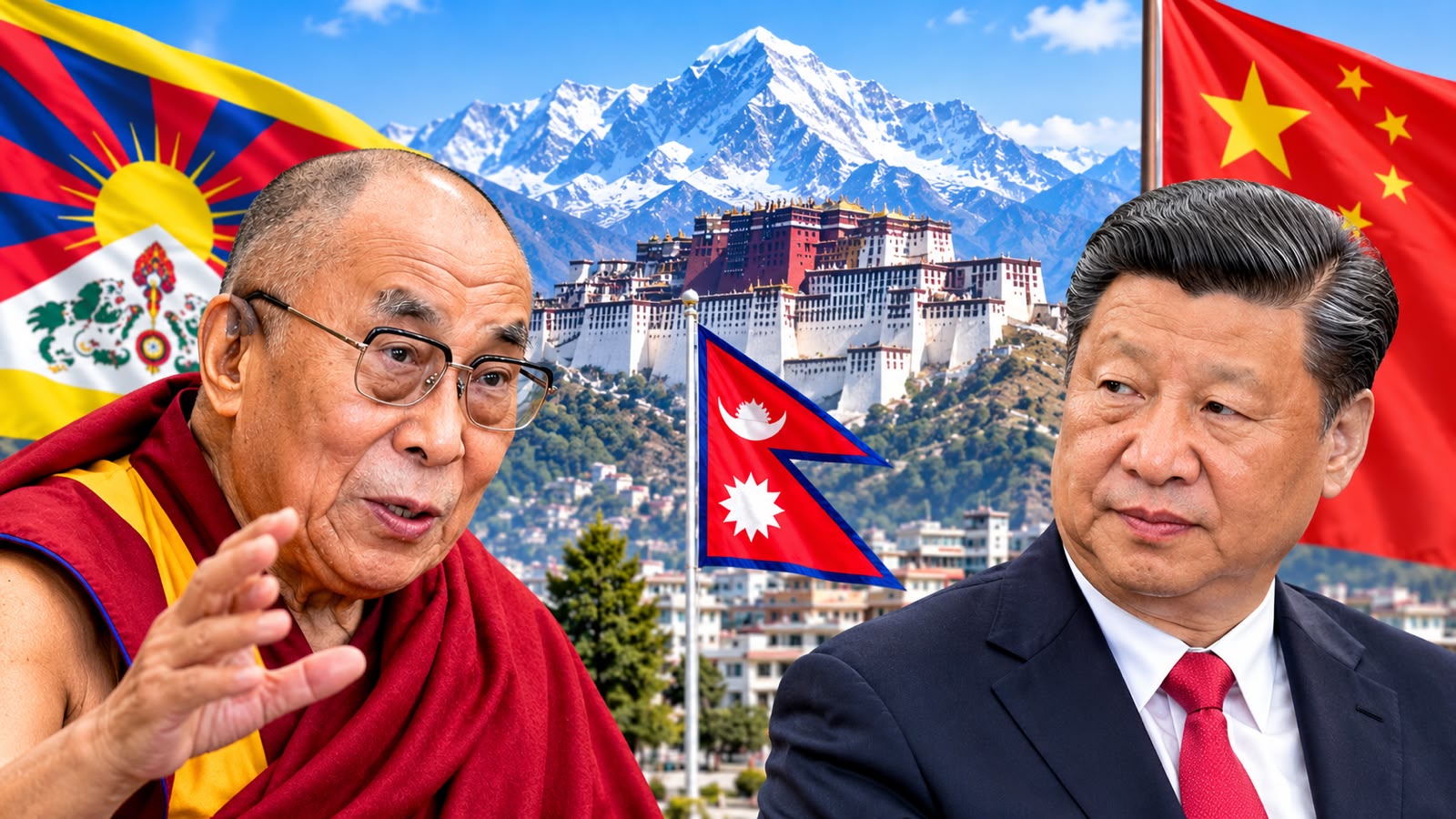
Kathmandu: Nepal’s northern neighbourhood and the Tibet issue, long considered sensitive due to the country’s geopolitical position, have once again become increasingly complicated. On one hand, activities by exiled Tibetan spiritual leader the Dalai Lama and his supporters in Nepal are reportedly gaining momentum. On the other, China has intensified political engagements and people-to-people exchanges with Nepal. These developments have placed Kathmandu at the centre of a delicate diplomatic balancing act, putting additional pressure on the Nepalese government, which has consistently maintained its commitment to the ‘One China Policy’.
Three members of the Tibetan Parliament-in-Exile are scheduled to arrive in Nepal tomorrow, November 19, from Dharamshala in India’s Himachal Pradesh. The delegation, including lawmakers Dawa Tsering and Chodak Gyatso, is not being viewed merely as a routine religious or cultural visit. The reportedly discreetly arranged trip is believed to be aimed at holding high-level political meetings in Kathmandu, as well as visiting the Chhoyozor Tibetan settlement in Bouddha–Jorpati, home to more than 5,000 Tibetan refugees, and several monasteries in the Dakshinkali area. Diplomatic circles have been discussing whether such visits are part of a broader effort to lay the groundwork for a possible visit to Nepal by the Dalai Lama, an initiative that has reportedly been pursued behind the scenes for some time. However, China has consistently exerted pressure on the Nepalese government to prevent the Dalai Lama from entering Nepal and to restrict activities considered anti-China or supportive of Tibetan independence.
Analysts have begun linking the increased activities of Dalai Lama supporters to the political developments following Nepal’s Gen Z uprising. When a government was formed under the leadership of Sushila Karki after the uprising, the Dalai Lama sent a congratulatory message for the first time in history, a gesture that was viewed as diplomatically significant. Meanwhile, references in the report of the Karki Commission, formed to investigate events surrounding the Gen Z uprising, suggesting that substantial quantities of weapons were stored in several monasteries across Nepal have raised serious questions about national security.
Several recent government decisions and activities involving senior political leaders have also fuelled suspicions regarding the government’s approach to the Tibet issue. The appointment of Ani Choying Dolma, who has faced allegations concerning her Tibetan refugee background, to lead the Lumbini Development Trust has attracted controversy. Similarly, the replacement of Nepal’s map featuring Lipulekh and Limpiyadhura with an image of the Lo Gekar Monastery in Mustang—regarded as a pilgrimage site by Tibetans supportive of the Dalai Lama—on Nepalese currency has sparked debate. Prime Minister Balendra (Balen) Shah’s visit to Mustang a few months ago also drew criticism, with some political circles alleging that the trip was intended to facilitate Tibet-related activities. These developments have raised questions about the consistency of the government’s position.
In the same context, the India visit of Rastriya Swatantra Party (RSP) Chairperson Rabi Lamichhane also came under controversy and scrutiny. Some time ago, reports emerged that Lamichhane was planning to travel to Dharamshala to meet the Dalai Lama, triggering widespread public interest. After the information became public, Lamichhane described his trip as a “personal pilgrimage,” reportedly feeling that attention had shifted towards his intended journey. He stated that he had visited religious sites and monasteries, including Neem Karoli Baba’s Kainchi Dham, before returning to Nepal. However, suspicions about possible undisclosed meetings with representatives of the Dalai Lama have yet to be fully dispelled.
While activities linked to Tibet have reportedly been increasing, China has also stepped up its diplomatic, political and people-to-people engagement in Nepal. In recent months, visits to China by Nepalese political leaders, lawmakers and young professionals have become increasingly frequent.
Currently, a 20-member delegation of lawmakers from the ruling RSP, led by the party’s General Secretary Bipin Kumar Acharya, is visiting China. Invited by the Communist Party of China (CPC), the delegation is visiting Sichuan, Zhejiang and Beijing, among other regions, to study China’s development model, governance practices, technology, industrial sectors and disaster management systems.
The delegation is scheduled to return to Nepal on November 26. Prime Minister Balendra Shah had instructed the lawmakers not to limit their visit to sightseeing but to explore concrete opportunities for cooperation in trade, investment, technology, tourism and agriculture. Earlier, from October 23 to 25, former President and senior CPN-UML leader Bidya Devi Bhandari had also visited China to participate in the Global Governance Forum, where she held high-level meetings.
Alongside political engagements, China has intensified cultural and professional exchange programmes targeting Nepal’s younger generation. As part of this initiative, 20 Nepali youths departed for China on Tuesday at 12:30 p.m. aboard a China Southern Airlines flight.
The participants were selected under the one-year Chinese Embassy Youth Pioneer Programme (CNYP), launched by the Chinese Embassy in Kathmandu for 2026. The selected group includes young entrepreneurs, activists and professionals who will travel to China to gain insights into its development practices, social and economic structures, and modernisation process.
The Chinese Embassy aims to establish a network of young Nepalis capable of contributing to Nepal’s social and economic development while developing the participants into ambassadors of cultural exchange and cooperation between Nepal and China.
Taken together, these developments indicate that Nepal is increasingly finding itself at the centre of mounting geopolitical pressure. On one side are the growing activities of Dalai Lama supporters and the indirect interests of Western powers; on the other is China, which is seeking the practical enforcement of Nepal’s commitment to the One China Policy through intensified diplomatic engagement and people-to-people exchanges.
In this increasingly sensitive geopolitical environment, Kathmandu faces the difficult task of balancing its foreign policy principles, national interests and diplomatic sensitivities towards its neighbours. How the Nepalese government navigates these competing pressures while maintaining its independent and non-aligned foreign policy has become a matter of growing public interest and concern.
Publish Date: November 18, 2026











Feedback