
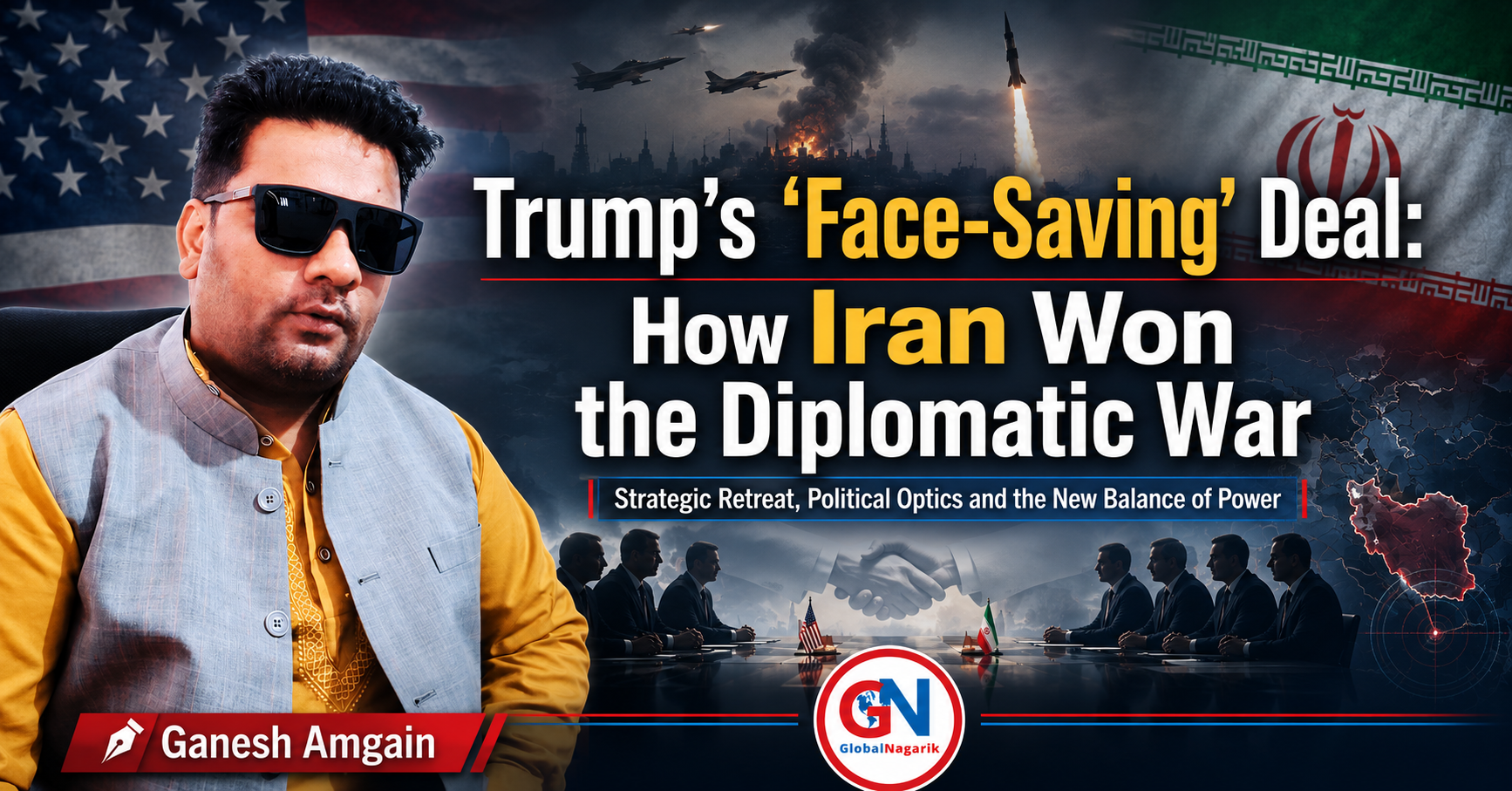
The recent preliminary agreement between the United States and Iran has brought a new and turbulent twist to global geopolitics. US President Donald Trump’s unprecedented haste to exit the war with Iran and the terms of the agreement have exposed a major vulnerability in American foreign policy. Around the world, this agreement is being viewed as Trump’s strategic surrender and a diplomatic victory for Iran, one that has completely altered the old balance of power in the Middle East.
Following months of intense tension, military confrontations, and devastating attacks, both nations agreed on an absolute historic framework before officially signing it in Geneva. Although the Trump administration and the White House have spun this as a major achievement for peace, the actual facts tell a different, embarrassing story. The US has been forced to make a humiliating retreat from its declared objectives of regime change in Iran and the total destruction of its nuclear program.
This preliminary agreement places a particular priority on reopening the ‘Strait of Hormuz’ waterway. Until February 2026, this route was entirely free and open, but the war triggered by America’s short-sighted policies forced its closure. Currently, under intense pressure from upcoming domestic midterm elections, fierce opposition from the American public, and plummeting popularity, the Trump administration saw no alternative but to accept Iran’s terms without question.
Consequently, analysts note that this agreement has shifted the balance of power in the Middle East away from the control of the US and Israel, tilting it in favor of nations like Iran and China. This sunset of American hegemony and the rise of regional powers provide a clear signal of how international diplomacy will unfold in the days ahead.
Trump’s Haste and Iran’s Diplomatic Victory
Behind President Donald Trump’s anxiety to hastily wrap up the war with Iran lie domestic political crises and severe damage to the US defense budget. Despite Trump’s initial grand claims of forcing Iran to its knees, destroying its oil industry, and reducing its economy to zero, he ultimately ended up seeking a ‘face-saving deal.’ Iran maintained an extremely firm stance at the diplomatic table, forcing the United States to accept harsh and unilateral conditions.
Due to this agreement, Iran has secured massive economic, military, and strategic advantages. Billions of dollars in Iranian assets frozen in various international banks for years are being released without hindrance – including $12 billion already confirmed by various sources to have been released prior to the signing. Furthermore, reports have emerged that Iran will receive a massive financial aid or compensation package worth nearly $300 billion under the guise of a post-war reconstruction fund, a detail that US Vice President JD Vance failed to clearly deny during a press conference.
According to Iranian Foreign Ministry Spokesperson Esmaeil Baghaei, despite the signing of this MoU, Tehran retains a deep-rooted historical mistrust toward Washington. Asserting that the history of American leaders is riddled with broken promises and betrayal, Iran maintained that it would not compromise on its security and strategic interests. In 2018, provoked by Israel, Trump tore up the Obama-era multilateral nuclear deal (JCPOA), calling it the worst deal in history. Ironically, experts now conclude that this new agreement he brokered himself is many times weaker and heavily favors Iran.
In a sensational revelation, it has come to light that during the preparation and drafting of this agreement, Trump completely ignored the serious counsel of his experienced diplomats, military commanders, and prestigious intelligence agencies like the CIA. CIA Director John Ratcliffe and Secretary of State Marco Rubio had cautioned Trump that Iran would not abide by the terms and would continue its nuclear activities covertly. However, Trump advanced this national security matter based on the advice of his son-in-law Jared Kushner and real estate billionaire Steve Witkoff, triggering widespread backlash and chaos within the US administration itself.
Ultimately, this preliminary agreement has further strengthened the political and social grip of Iran’s Islamic Revolutionary Guard Corps (IRGC) in the Middle East. Trump’s rhetoric of bringing democracy to Iran, changing its regime, and inciting a public uprising proved to be a castle built on sand. Compared to its sanctioned and weakened state before the war, American military confrontation and this humiliating agreement have allowed Iran to emerge twice as powerful and organized, establishing itself as an indispensable superpower in the Middle East – confirming a massive defeat for American diplomacy.
The Reality of the Strait of Hormuz and the Nuclear Program
The ‘Strait of Hormuz’ is the world’s most sensitive and strategic oil supply route, through which nearly one-third of the global energy trade passes. Under this agreement, while there is consent to reopen the waterway, Iran has astonished the world by announcing heavy service fees on all international vessels transiting the route. Employing diplomatic cleverness, Iran has avoided calling this a direct ‘toll tax,’ crafting instead a new legal framework to extract huge sums under various titles such as transit operational fees, environmental protection charges, maritime security fees, and vessel insurance surcharges.
The direct and clear implication of this diplomatic move is that the Strait of Hormuz will no longer be entirely free for global trade as it once was, and Iran’s direct monopoly over it will be cemented permanently. Although President Trump celebrated on Truth Social and the media, claiming success in reopening the waterway, many countries worldwide will now have to fill Tehran’s coffers to trade oil and gas through the strait. Iran has preserved the military capability and strategic right to shut down this route within seconds if it senses even the slightest future security threat, forcing global supply chains and stock markets to perpetually dance to Tehran’s tune.
Regarding the actual context of the nuclear program, the Trump administration is promoting this as an historic diplomatic triumph, claiming Iran has given a written commitment never to build nuclear weapons. However, the reality of international politics is that Iran had already accepted this when it signed the Non-Proliferation Treaty (NPT) in 1968, consistently maintaining that its nuclear development is solely for civilian energy purposes. Iran’s Supreme Leader Ayatollah Ali Khamenei also issued a religious fatwa against the manufacturing of weapons of mass destruction years ago; hence, Trump labeling this as a breakthrough achievement of the new deal is laughable.
The biggest and most serious flaw of this new agreement is its failure to impose any concrete or binding restrictions on Iran’s uranium stockpiles and its lethal ballistic missile program. While the 2015 Obama-era agreement explicitly mandated shipping 97 percent of Iran’s enriched uranium out of the country to Russia alongside rigorous international monitoring (IAEA inspections), Trump’s new deal contains no such strict provisions. Iran has been granted the leeway to continue uranium processing and enrichment on its sovereign soil, leaving nothing to stop it from becoming a nuclear-armed state at any moment in the future.
According to experts, following the recent US attacks, Iran views the development of nuclear weapons as the only reliable guarantee for its survival and sovereignty. Through covert strategic and technical ties with North Korea and China, Iran has advanced its missile industry to a level where external sanctions no longer affect it. Trump’s incomplete, rushed, and flimsy agreement has handed Iran a golden opportunity to stride firmly along its nuclear path with legal protection, while America has shut the very doors required to halt or inspect these nuclear activities.
Israel’s Discontent and the Game to Sabotage the Deal
This preliminary US-Iran agreement has dealt the heaviest blow, betrayal, and shock to Israel, considered America’s most dependable ally in the Middle East. Israel was entirely excluded from both the secret and open processes of this lengthy diplomatic negotiation, and was kept completely in the dark while the core terms were being hammered out. Expressing fierce outrage over the agreement, Israeli Prime Minister Benjamin Netanyahu has openly criticized Washington’s feeble policy in the media. Israel views this move as a dangerous gamble with its survival and national security, labeling it an historic betrayal by the US administration.
Prime Minister Netanyahu’s primary strategy and political objective was to leverage American military might to uproot Iran’s Islamic regime and establish Israel as the sole, unchallenged regional superpower in the Middle East. However, President Trump’s sudden U-turn and hasty agreement have completely shattered Israel’s decades-old strategic dream. Israeli military commanders and officials from the intelligence agency ‘Mossad’ have warned that this agreement is highly lethal for Israel, and will financially and militarily embolden Iran-backed militant groups like Hezbollah, Hamas, and the Houthis to be far more aggressive.
Amid this extreme anger and insecurity, Israel has announced that it will intensify rather than halt its military operations and airstrikes in Lebanon, vowing to take independent action against Iran. In fact, under the guise of the war with Iran, Israel had harbored a covert blueprint to seize control of southern Lebanon and the entirety of Gaza, exploiting the diplomatic chaos to advance its controversial ‘Greater Israel’ project. If absolute peace is established in the Middle East on Iran’s terms and the balance of power shifts toward Tehran, Israel’s expansionist plans will inevitably grind to a permanent halt.
Consequently, ahead of the formal signing ceremony scheduled for June 19 in Geneva, Israel appears openly engaged in a dangerous game to disrupt or sabotage this US-Iran peace pact. Minutes after the agreement was announced, Israel launched fierce bombardments on Lebanon’s capital, Beirut, and strategic Hezbollah strongholds, attempting to provoke Iran into a military retaliation at all costs. If Iran takes even a minor military step in response to Israel’s provocation, the agreement will automatically collapse, plunging the region back into the vortex of a catastrophic war – which remains Netanyahu’s ultimate diplomatic weapon to preserve his power and position.
This unprecedented rift between the United States and Israel has even triggered a severe political fracture in the personal friendship between Trump and Netanyahu, leading to a reported phone call where Trump shouted at Netanyahu, calling him “crazy.” Inside Israel, hardline ministers like Ben-Gvir have kicked off a rebellion, asserting that they are not Washington’s pets and will continue the war regardless of US pressure. Due to Israel’s extreme discontent and thirst for war, the question of whether this agreement will survive before June 19 has captured the world’s attention, leaving Middle Eastern politics highly explosive and volatile.
In conclusion, this preliminary agreement between the United States and Iran has opened the door to a far-reaching and historic transformation in Middle Eastern geopolitics and the global balance of power. It has made it clear on the international stage that a sovereign and self-respecting nation cannot be permanently suppressed or bent through military force and economic sanctions alone. The United States has suffered a bitter defeat against Iran both on the battlefield and at the diplomatic table, severely weakening its image as the sole superpower and laying bare its strategic helplessness.
The greatest challenge ahead now is to prevent potential military disruptions, provocations, and sabotage plots by Israel before the formal signing ceremony on June 19. If successfully implemented, this agreement will establish Iran as the undisputed political and economic player in the region, bringing an end to American dominance. Ultimately, rather than fostering lasting peace, Trump’s hasty and politically self-serving move has sown the seeds for a new form of regional cold war and nuclear arms race, the severe consequences of which the world will have to endure for decades to come.
(The author is a former military officer of the Nepali Army and a scholar of Political Science.)
Publish Date: June 17, 2026





Feedback