
International law and global politics view the transit and maritime rights of landlocked nations as highly sensitive, complex and deeply rooted in justice. Geographically isolated from direct access to the sea, these countries often find themselves sidelined from the mainstream of global trade and development. To counter this economic disadvantage, the international community has established various legal frameworks. These provisions do not merely liberate landlocked nations from their geographical shackles; they offer a robust legal foundation that safeguards their state sovereignty and economic independence. For these nations, free access to the sea is a vital lifeline – a fundamental right claimed on humanitarian, legal and economic grounds. Driven by geographical destiny, utilizing a neighbor’s territory becomes an absolute, non-negotiable prerequisite for their holistic development.
Conversely, transit or coastal states view territorial sovereignty as an supreme, inviolable and deeply sensitive matter. It grants them absolute, indivisible and independent control over the land, airspace and waters within their borders. Always vigilant about safeguarding national security, public health, social integrity and domestic law, coastal states tend to view transit facilitation as a gesture of mutual goodwill and bilateral agreement rather than an inherent, absolute right. This fundamental divergence between transit rights and territorial sovereignty frequently triggers diplomatic friction, political maneuvering and misunderstandings in international trade and transit politics. Until a reliable environment of mutual trust bridges the natural necessity of landlocked nations with the genuine security concerns of coastal states, transit frameworks will remain vulnerable to instability.
For Nepal, a landlocked nation sandwiched between two of the world’s largest emerging economies, these international rights form the bedrock of national interest and economic prosperity. The transit treaties and agreements signed with neighboring countries are anchored in international legal principles, allowing Nepal to rise above its geographical limitations and integrate with global markets. In the contemporary world order, the strategic exercise of these rights, coupled with proactive diplomacy, holds the key to Nepal’s economic transformation. Balancing these two inherently contrasting concepts remains the primary challenge of modern bilateral agreements. Resolving this tension between rights and duties demands consistent, sophisticated diplomacy.
While being landlocked is an inherent economic challenge, it can be transformed into a strategic opportunity through calculated policy and adroit diplomacy. Throughout its history, Nepal has weathered numerous transit crises and disruptions, experiences that have ultimately matured its national consciousness. Nepal’s long-term interests lie in balancing its international legal rights with the sovereign sensitivities of its neighbors. In this context, maintaining highly active diplomatic channels to forge win-win outcomes is vital.
International Law and Transit Freedom
To mitigate the friction between free access and territorial sovereignty, international law has established several landmark principles. Part X of the United Nations Convention on the Law of the Sea (UNCLOS), particularly Article 125, explicitly recognizes the right of landlocked states to access the sea and return from it. This framework aims to offset geographical disadvantages, ensuring level participation in global trade. By characterizing transit facilities as a universal obligation, the convention underscores the economic independence of landlocked countries, enabling vulnerable economies to utilize maritime trade to expand their foreign commerce. This right is fundamental to both the survival and prosperity of landlocked nations.
However, the transit rights granted by international law are neither absolute nor unconditional. The convention simultaneously equips coastal or transit states with the authority to take necessary measures to protect their legitimate interests, national security, and public order. This implies that exercising transit rights must not infringe upon or compromise the sovereignty and domestic legislation of the host nation. Because international regulations balance the interests of both parties, landlocked states seeking transit facilities must respect the sovereign sensitivities of transit states. This establishes that the exercise of rights must always be responsible and balanced.
Under these international legal frameworks, transit cargo is strictly exempt from customs duties, discriminatory taxes, or extra transit-related tariffs. Transit nations are entitled to levy only justifiable charges intended to cover infrastructure maintenance, road usage, rail services, or direct administrative costs. This clause provides significant financial relief to landlocked countries, helping their goods remain competitive in international markets. Nevertheless, to prevent abuse of these facilities, transit states retain the right to enforce necessary legal documentation and verification procedures at customs checkpoints, which should not be misconstrued as deliberate trade barriers.
In the contemporary era, the definition of “means of transport” has expanded dynamically. It no longer comprises just traditional roads and railways, but also encompasses inland waterways, gas and oil pipelines, and electricity transmission grids. This diversification reinforces the supply chain resilience, industrial development, and energy security of landlocked countries. Another cornerstone of transit freedom is the principle of non-discrimination, which legally prohibits transit nations from executing discriminatory practices against the cargo of landlocked states.
Ultimately, international forums provide only broad guidelines, principles, and global frameworks. In practice, bilateral agreements remain the decisive and supreme mechanism for implementing these doctrines on the ground. Because every nation possesses unique geography, distinct political ties, and specific strategic sensitivities, localized diplomacy and mutual understanding offer the only practical solutions. International law serves as a sturdy foundation, but designing operational and pragmatic workflows upon that foundation relies entirely on sustained dialogue and bilateral diplomacy between the two concerned nations.
Security Concerns and Customs Control
Security concerns remain a highly sensitive and pivotal element in the dynamic between landlocked and transit nations. Transit states stay permanently alert to the threat of transit routes being exploited for illegal arms trafficking, smuggling, narcotics trade, human trafficking, or cross-border terrorism. Because such illicit activities pose severe threats to internal security, national integrity and domestic stability, safeguarding its territory is a transit state’s sovereign right, duty and primary obligation. Consequently, coastal states refuse to compromise on security parameters when granting transit access.
To monitor cargo movement within their borders, transit nations implement rigorous customs protocols, seal containers, and perform physical inspections of suspicious cargo. Conversely, landlocked nations often perceive such intense surveillance and administrative delays as non-tariff barriers designed to choke trade. Redundant security checks, bureaucratic red tape, and multi-layered customs clearances exponentially inflate both transit time and logistics costs. This delay hinders manufacturers and traders from delivering goods to markets on time, causing severe financial losses that undermine trade sustainability.
These legal and administrative bottlenecks often dilute the core spirit of free transit access. Ambiguous administrative procedures, bureaucratic inertia, and a lack of modern technical infrastructure frequently cause cargo to stall at borders for months. The financial burden of these delays falls directly on the consumers, domestic industries, and overall economy of the landlocked country. Excessive control disguised as security measures raises transaction costs and fosters an atmosphere of suspicion and distrust between the two nations, stalling economic cooperation.
To bridge this divide and balance security with trade efficiency, modern digital systems and automated customs processes have become indispensable. Deploying advanced technologies ensures secure and rapid cargo movement, offering transit nations robust security guarantees. Embracing technology injects transparency into customs procedures, minimizes human intervention, ensures reliable security screening, and fundamentally revolutionizes trade facilitation. This approach addresses the core concerns of both nations simultaneously, dispelling mutual distrust.
The objective of customs control must be to regulate and legitimize trade, not to obstruct it. When customs procedures are modernized and predictable, businesses can formulate accurate trade strategies. Shifting security frameworks toward technological solutions slashes cross-border trade costs and boosts the efficiency of revenue administrations on both sides. Therefore, transitioning from conventional security mechanisms to modern technological solutions is an imperative of the current era.
Nepal-India Transit Practices and Diplomacy
The historical transit relationship between Nepal and India, marked by various shifts, serves as a vivid case study of this conceptual friction. Nepal has consistently championed transit as its inherent right as a landlocked country, a claim backed by international law and vital for its national development. India, on the other hand, has traditionally viewed the issue through the lens of its regional sovereignty, the sensitivities of an open border, and its overarching national security framework. These differing outlooks have historically triggered periodic diplomatic standoffs and economic friction, influencing the wider bilateral relationship.
Looking back at history, the transit deadlock of 1989 caused a severe, long-term rift between the two nations. Nepal maintained that trade and transit should be governed by separate treaties, arguing that while trade arrangements fluctuate, transit is a permanent right of a landlocked nation. Conversely, India sought to bundle both components into a single strategic framework. This ideological stalemate led to a 15-month trade disruption that severely impacted Nepal’s economy, disrupted daily life, and damaged diplomatic trust between the neighbors.
Similarly, following the promulgation of Nepal’s new constitution in 2015, border disruptions and supply chain blockades reflected this identical underlying tension. Nepal projected the situation on the global stage as a humanitarian crisis, a violation of landlocked nations’ rights, and a breach of international norms. India, meanwhile, attributed the transit disruption to internal political unrest and security hazards in the border region. Such sensitive episodes leave a trail of distrust and political bitterness in diplomatic circles, taking considerable time and effort to heal.
Nevertheless, recent years have witnessed positive shifts in Nepal-India transit cooperation. Moving beyond its traditional reliance on the Kolkata and Haldia ports, Nepal now has access to the deep-water port of Visakhapatnam, as well as Mundra and Dhamra ports. At the border, direct rail and road connectivity have been enhanced through the Dry Port at Birgunj and various Integrated Check Posts (ICPs). This multi-port access has diversified Nepal’s trade routes, reduced single-route vulnerability, and improved its strategic bargaining position.
Moving past outdated legacy systems, the introduction of the Electronic Cargo Tracking System (ECTS) and digital sealing has reduced the need for physical inspections by Indian customs. This technological intervention has made transit transparent, secure, and swift, significantly curbing prohibitive demurrage charges at ports. For a permanent solution to these logistical challenges, both nations must keep their technical committees active. Sustained diplomatic engagement aimed at understanding mutual sensitivities and constraints remains vital to deepening bilateral ties.
Nepal-China Agreement and Strategic Alternatives
The Transit Transport Agreement and its protocol signed between Nepal and China represent a far-reaching strategic milestone in Nepal’s trade history. Formalized in 2016 with its protocol signed in 2019, this framework broke Nepal’s historic, single-country transit dependence on its southern neighbor. The agreement opened a viable alternative gateway to global markets through the north, broadening Nepal’s diplomatic options and reinforcing its sovereign identity on the international stage.
This historic pact grants Nepal the legal right to utilize four Chinese maritime ports -Tianjin, Shenzhen, Lianyungang and Zhanjiang – and three dry ports – Lanzhou, Lhasa, and Shigatse. It also incorporates critical border points such as Tatopani, Rasuwagadhi (Kerung), Korala and Kimathanka. Following the vulnerabilities exposed by the 2015 border disruptions, diversifying trade routes became an absolute necessity. This framework provided Nepal with the strategic baseline and confidence needed to sustain its external supply chains under any circumstances.
Yet, despite its diplomatic success, the practical implementation of this agreement faces severe obstacles due to rugged Himalayan topography and infrastructure deficits. Border roads remain narrow and highly susceptible to landslides, while Chinese maritime ports are located over 3,000 kilometers away from Nepal’s borders. Due to these vast distances, the freight costs and transit times for importing goods via China remain high, limiting the immediate commercial viability of this route for everyday traders.
Additionally, Nepali entrepreneurs continue to navigate procedural hurdles, including language barriers, differing customs technologies, incompatible documentation formats, and distinct banking systems. Nonetheless, the transit agreement with China remains an invaluable “strategic alternative” that strengthens Nepal’s bargaining leverage and national security. To unlock the full economic benefits of this treaty, Nepal must prioritize northern infrastructure development, upgrade the Arniko and Pasang Lhamu highways, and complete highly anticipated projects like the Kerung-Kathmandu railway.
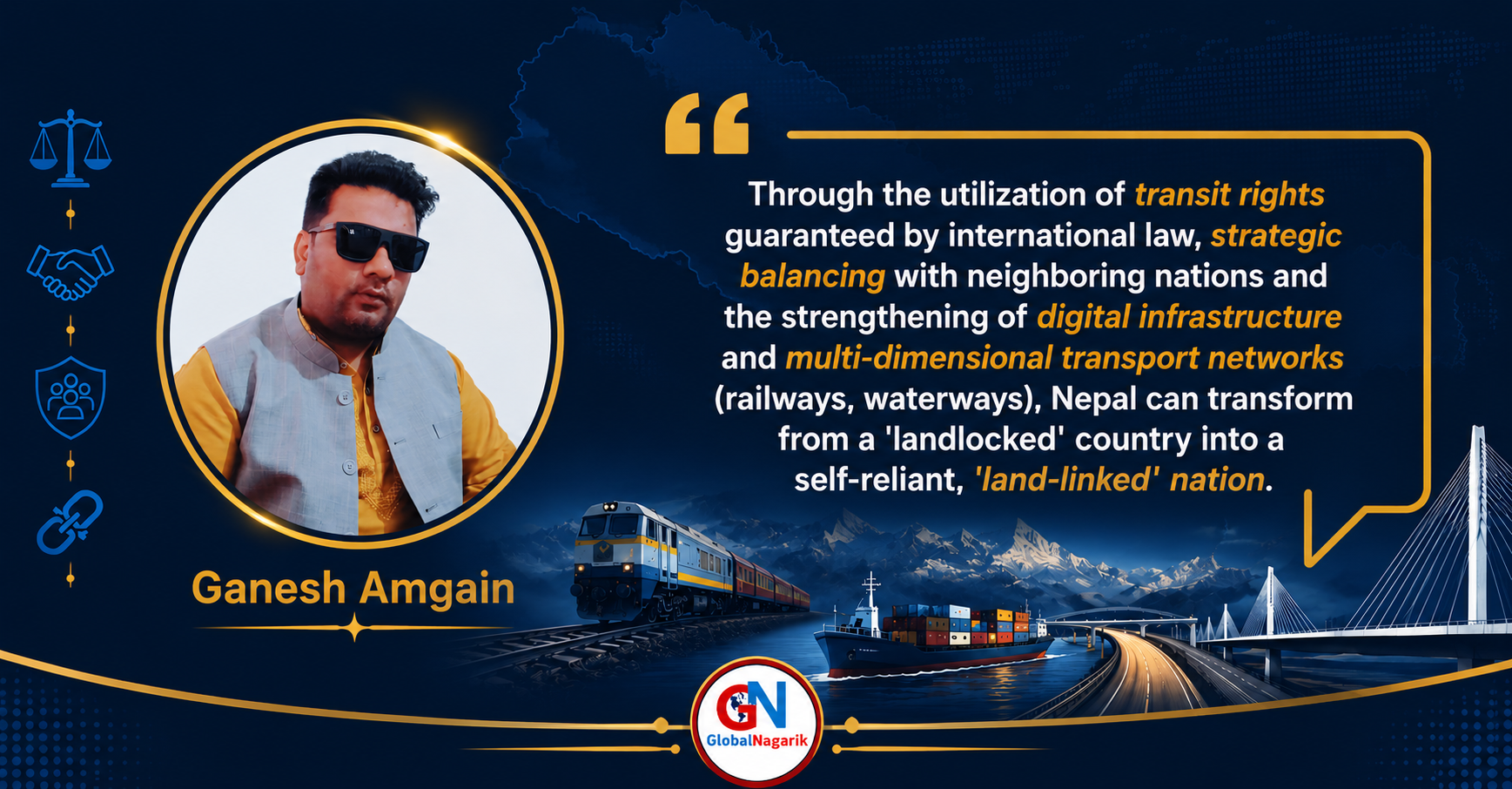
This agreement has laid the diplomatic groundwork to transform Nepal from a “landlocked” to a “land-linked” nation. Achieving this transformation requires sustained technical dialogue and regular joint mechanism meetings with China. Nepal should approach this alternative not as a geopolitical card against India, but as a natural progression toward economic diversification and national interest. Over the long term, this strategy will elevate Nepal’s economic sovereignty.
Shared Interests and Infrastructure Transformation
Viewing free access and territorial sovereignty as inherently antagonistic concepts is counterproductive in the modern globalized economy. In an era of interconnected global trade, the balanced integration of these two principles is essential for driving mutual economic prosperity. Both sides must acknowledge each other’s geographical constraints and security anxieties, shifting toward a model based on shared benefits and mutual gains. Transit facilitation should no longer be viewed as a one-sided concession granted to a landlocked neighbor, but rather as a shared opportunity to expand regional economic networks.
To translate the rights of landlocked nations from legal paper into practical reality, developing modern physical infrastructure within the country and along its borders is an absolute prerequisite. Nepal must expand the capacity of its Integrated Check Posts (ICPs) and Dry Ports at major trade gateways to streamline cargo movement. Equipping customs laboratories with advanced testing machinery is essential for swift quality clearance, which lowers international trade costs and enhances the competitiveness of Nepali goods in global markets.
Transitioning to a fully digital, paperless transit system requires integrating Nepal’s customs frameworks with those of its neighbors. Making the Electronic Cargo Tracking System (ECTS) mandatory and efficient across all trade corridors will automatically minimize unauthorized en-route inspections and administrative delays. This technological interoperability slashes transaction costs and fosters institutional accountability, ensuring a transparent, secure transit process that addresses the core concerns of all nations involved.
Securing cost-effective transport alternatives requires sharp diplomatic focus on expanding rail and waterway networks. In line with agreements signed with India, commercially operationalizing inland waterways via the Ganges River could significantly reduce freight expenses compared to road transport. Furthermore, Nepal must look beyond bilateral diplomacy and actively engage with regional and multilateral frameworks, such as the BBIN (Bangladesh, Bhutan, India, Nepal) initiative, to secure reliable and cost-effective access to Bangladeshi ports.
For a nation positioned between two economic giants, embracing trilateral cooperation offers a strategic safety net and an immense economic opportunity. Instead of remaining a passive “buffer state” between two powers, Nepal can transform itself into a dynamic economic bridge linking China and India. Developing these north-south transit corridors will mitigate the risks associated with single-country dependence and provide a sustainable boost to the economic development of the entire region.
Conclusion
A landlocked nation’s right to free access to the sea and a transit state’s right to territorial sovereignty are both deeply entrenched, inviolable principles of international law. The disputes that arise between these two sides stem less from legal vacuums and more from diplomatic shortsightedness, political expediency, and mutual mistrust. Therefore, while asserting its legal rights, a landlocked nation must remain responsible and sensitive to the internal security and sovereignty of its neighbors as a core tenet of its diplomacy.
Although altering geography is impossible, strategic diplomatic vision, political will, and the application of modern technology can mitigate historical misunderstandings. Both nations must resist using transit facilities as political leverage or tactical tools, focusing instead on turning them into stable pillars of long-term economic partnership. Mutual goodwill, non-discriminatory legal treatment, and continuous collaboration are the only mechanisms that can protect the interests of both sides while establishing a stable transit ecosystem.
Through targeted diplomatic engagement and robust domestic infrastructure development, Nepal can convert its geographical constraints into strategic advantages. A well-defined national policy backed by consistent political resolve will guide Nepal from being “landlocked” to becoming truly “land-linked,” paving the path for enduring prosperity. Achieving this goal requires political stability, policy continuity, and a unified foreign policy aligned strictly with national interests.
(The author is a former military officer of the Nepal Army and a scholar of Political Science.)
Publish Date: June 20, 2026









Feedback