
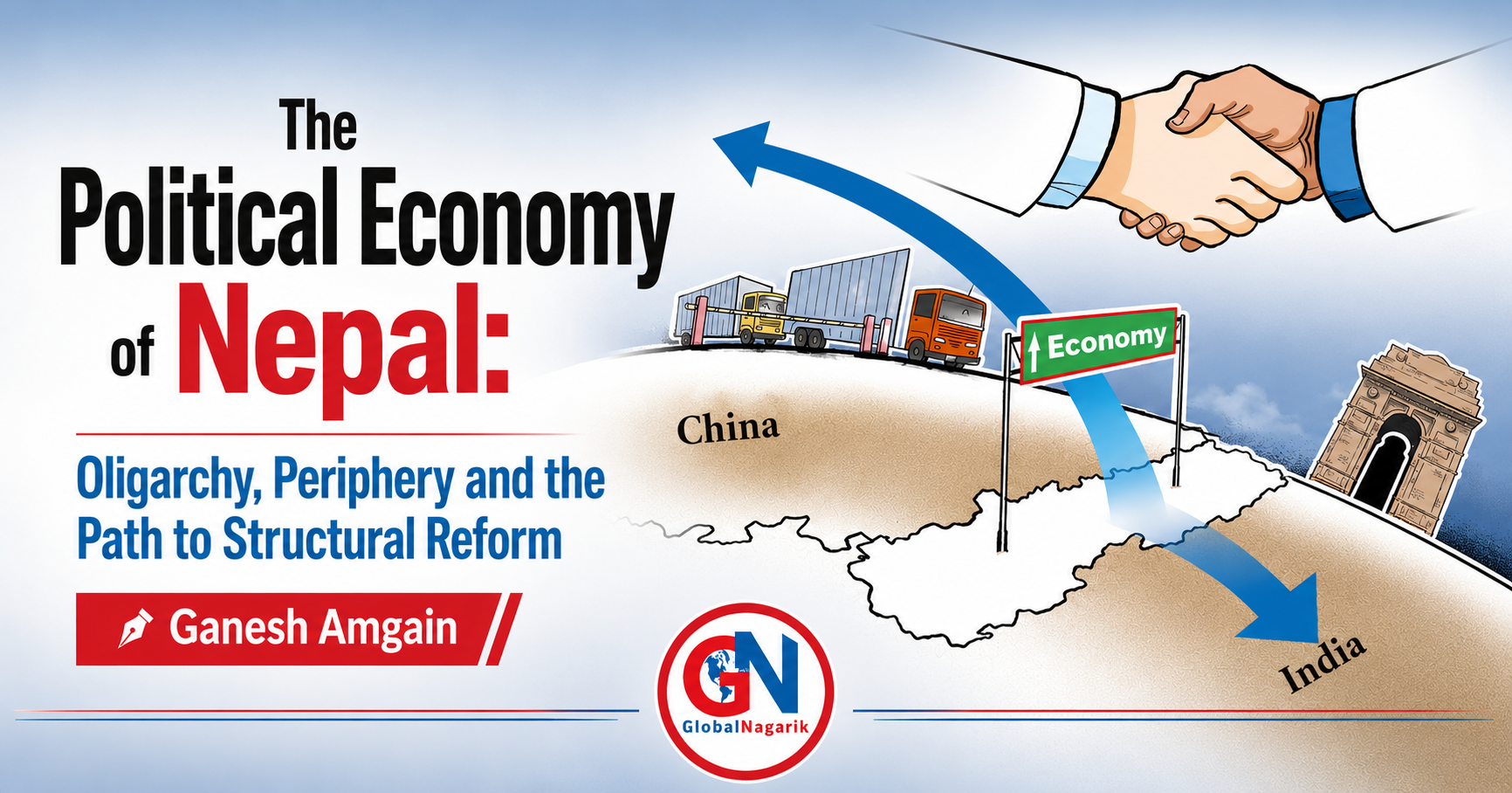
– Ganesh Amgain
Nepal’s developmental trajectory presents a classic paradox: continuous shifts toward progressive political systems alongside a stagnant socioeconomic framework. The country has transitioned from an absolute monarchy to a multiparty democracy and finally to a federal democratic republic. Yet, the foundational mechanics of its economy remain deeply extractive. The structural concentration of power has merely evolved rather than dissolved. Historical family-based exploitation during the Rana regime and elite capture under the Panchayat era have given way to modern crony capitalism. This economic stagnation is further worsened by systemic vulnerabilities, including over-reliance on remittances, regional imbalances and global peripheral positioning. To rescue the economy from this trap, Nepal must urgently transition from a consumption-driven model to a production-oriented system built on technological modernization, localized value chains and strict meritocracy.
Elite Capture and the Mechanics of Crony Capitalism
The political history of Nepal is a continuous narrative of power concentration within a shifting but highly exclusive elite class, historically referred to as the Abhijat Varga. Following the unification of the state in the late 18th century, power was concentrated within a small circle of court insiders and military elites. During this foundational period, absolute loyalty to the monarch and the discretionary distribution of land ownership served as the primary tools for economic exploitation, effectively pushing ordinary citizens to the margins.
The rise of the Rana oligarchy in 1846 narrowed this power structure even further. Governance was restricted to a hereditary roll-call system where nepotism, arbitrary decrees and institutionalized sycophancy defined statecraft. The state treasury was treated as personal income, and merit-based advancement was completely suppressed.
While the democratic openings of 1951 and 1990 brought an educated middle class and ideologically driven elites into the political arena, the underlying nature of state power remained unchanged. The post-1990 transition to open-market liberalization was poorly regulated, allowing a powerful political-business nexus to emerge. This dynamic evolved into a highly institutionalized “Castlecary” following the 2006 peace accord.
Today, a small syndicate of top political leaders and their business associate’s controls access to state resources. Because the electoral system is incredibly expensive, politicians rely heavily on funding from real estate speculators, import cartels and public contractors. This financial dependency results in policy capture, where legislation, tax exemptions and public procurement rules are custom-tailored to benefit specific interest groups, sidelining genuine entrepreneurs. Even well-intentioned reforms have been undermined by this elite capture. For instance, the constitutional quotas designed to empower marginalized groups – such as women, Dalits and Madhesis – have largely been co-opted by wealthy, politically connected individuals within those very communities. This dynamic leaves the most vulnerable citizens without real representation.
Federalism and the Pitfalls of Decentralized Corruption
The economic rationale behind Nepal’s transition to a federal structure in 2015 was to dismantle the old, Kathmandu-centric unitary model and establish social justice through decentralized development. For decades, centralized governance starved peripheral regions like the Madhes, Karnali and Sudurpashchim provinces of capital, despite their rich natural endowments in water, agriculture and medicinal herbs. Although the 2015 Constitution established seven provinces and 753 local tiers as autonomous economic units, the actual economic indicators reveal persistent regional inequality.
Bagmati Province alone commands roughly 36% of the national Gross Domestic Product (GDP), driven by concentrated capital and infrastructure in the Kathmandu Valley. In stark contrast, remote regions like the Karnali and Sudurpashchim provinces contribute less than 5% each to the national economy. Furthermore, true fiscal autonomy does not match this administrative decentralization. Provincial governments remain heavily dependent on the federal center, relying on Kathmandu for more than 70% of their budgetary allocations through fiscal equalization and conditional grants.
Instead of channeling these limited funds into productive, high-return infrastructure, local governments frequently misallocate resources toward politically popular but economically non-productive projects, such as concrete view-towers and religious temples. This misallocation is worsened by exceptionally low capital expenditure rates and a bureaucratic culture that delays development work until the final month of the fiscal year – a problematic practice locally known as Asare Bikas. This rushed spending results in poor-quality infrastructure that washes away during the monsoon, benefiting only local contractors and political middlemen. To correct these imbalances, provincial governments must shift their focus to competitive advantages based on their geography. Agricultural regions require investments in cold storage and supply chain networks, while mountainous and river-basin provinces must utilize public-private partnerships to develop hydropower, tourism and high-value herbal processing.
The Remittance Trap, Unemployment and Brain Drain
Nepal’s macroeconomic stability currently rests on an unstable foundation: the export of its human capital. The domestic labor market suffers from severe structural imbalances. The formal education system remains overly academic and detached from market realities, producing thousands of graduates with theoretical degrees but no practical skills. This mismatch has created a critical shortage of technical labor alongside high rates of educated unemployment.
Unable to find dignified employment at home, over two thousand young Nepalis migrate abroad daily for low- and semi-skilled labor, primarily to the Gulf Cooperation Council (GCC) countries and Malaysia. While the resulting remittance inflows – which hover around 25% of the GDP – sustain household consumption and keep poverty figures artificially low, they have trapped the country in a dangerous cycle of per dependency.
This dynamic creates a form of Dutch Disease within the local economy. Remittances drive demand for imported consumer goods rather than fueling domestic manufacturing or agricultural growth. Consequently, the state relies heavily on customs duties collected at import checkpoints to fund its recurring administrative expenses, making it a passive beneficiary of youth displacement. For the ruling class, this migration serves as a convenient safety valve, sending politically active, frustrated young people abroad before their discontent can turn into domestic political unrest.
Simultaneously, the country is facing a severe brain drain as highly skilled professionals, students and academics migrate to Western Europe, North America and Australia. This mass departure strips Nepal of the human capital required to build a modern economy. High interest rates, bureaucratic red tape and systemic political interference further discourage young entrepreneurs, leaving local startups and small businesses struggling to survive.
Peripheral Position and the Geopolitical Trap
In the framework of world-systems analysis, Nepal occupies a classic “peripheral” position. It serves primarily as a provider of cheap labor and raw materials to the global market, while remaining entirely dependent on the industrialized “core” for manufactured goods, technology and developmental capital. This peripheral vulnerability is rooted in regional geography. Surrounded on three sides by India, Nepal has historically struggled with a lopsided trade relationship and vulnerable transit access. This reliance was made clear during the border blockades of 1989 and 2015, which caused severe domestic shortages and highlighted the dangers of geographic isolation.
While Nepal has attempted to diversify its transit options by signing trade protocols and joining China’s Belt and Road Initiative (BRI), the difficult Himalayan terrain makes large-scale commercial transport through northern routes logistically challenging and expensive. Consequently, Nepal remains vulnerable to regional pressures, often turning its internal borders into strategic leverage points for external powers.
This economic vulnerability leaves Nepal susceptible to what can be termed a “dependence syndrome.” A substantial portion of the country’s national infrastructure budget is funded via external loans and foreign aid. This dynamic often allows international donor agencies to dictate domestic policies, pushing projects that reflect external priorities rather than local realities. Furthermore, the intensifying geopolitical competition between India, China and Western powers introduces significant strategic volatility. Nepal risks becoming a diplomatic battleground, where foreign assistance packages are increasingly tied to security alignments rather than genuine economic partnership.
Strategic Blueprint for Structural Economic Reform
To move past its peripheral limitations and break free from the remittance trap, Nepal must execute a coordinated, phased transition toward an investment-friendly, production-oriented economy. This shift requires moving away from short-term fiscal fixes and implementing a long-term economic strategy focused on industrial growth and institutional transparency.
In the short term, covering the first one to two years, the state must mandate strict digital governance across all local procurement processes to curb leakages. Simultaneously, launching a state-backed Startup Seed Fund with low-interest loans can provide immediate relief to domestic innovators.
Moving into the medium term, spanning three to five years, the focus should expand toward setting up robust provincial cold-storage chains and dedicated agricultural hubs to ensure food security and import substitution. This phase also demands an overhaul of school curricula to emphasize technical and vocational skills over purely theoretical fields.
In the long term, looking five or more years ahead, Nepal must fully transition away from its structural reliance on import-based customs duties toward production-based domestic revenues. This must be complemented by establishing multi-modal freight corridors across northern borders to achieve true trade diversification.
Urgent Institutional Upgrades
The following targeted structural reforms are necessary to restore economic health and build resilience against external shocks:
Dismantling Cartels and Policy Transparency: In the immediate phase, Nepal must introduce strict anti-trust legislation to break up business syndicates in transport, agriculture and banking. Eliminating arbitrary tax exemptions and closing the loopholes that enable policy capture by political-business cartels is non-negotiable for a level playing field.
Complete Digitization of Public Administration: Within a 12-month horizon, the government must migrate all procurement, land administration, licensing and tax collection systems to transparent digital platforms. This transition will reduce direct bureaucratic gatekeeping, eliminate middleman interference and curb localized administrative corruption.
Restructuring of the Education System: With a 24-month horizon, the state must shift the educational focus away from purely theoretical university degrees and toward technical, vocational and digital literacy tracks. Aligning public education with local market demands will produce a workforce capable of supporting domestic industries rather than exporting labor.
Optimizing Fiscal Federalism and Local Investments: As a matter of continuous execution, federal grant allocations must be linked directly to the capital expenditure performance of provincial and local governments. Transitioning from small-scale municipal spending to public-private partnerships focused on provincial economic corridors, high-value agriculture and clean energy will ensure that local governance becomes an engine of production.
Conclusion
The geopolitical reality remains clear: Nepal cannot change its location between two rising economic giants. However, it can change its role from a passive buffer state to an active economic bridge. This transformation requires building reliable multi-modal transport lines, maintaining strict diplomatic neutrality and cultivating an unyielding commitment to domestic accountability.
The rise of a more connected, tech-literate younger generation – alongside growth in the domestic IT sector and specialized tourism – shows that change is possible. However, spontaneous entrepreneurial success is not enough on its own. Nepal’s long-term economic stability depends entirely on structural changes: eliminating corrupt middleman networks, enforcing the rule of law and building an economy powered by internal production rather than exported labor.
Publish Date: June 15, 2026








Feedback