
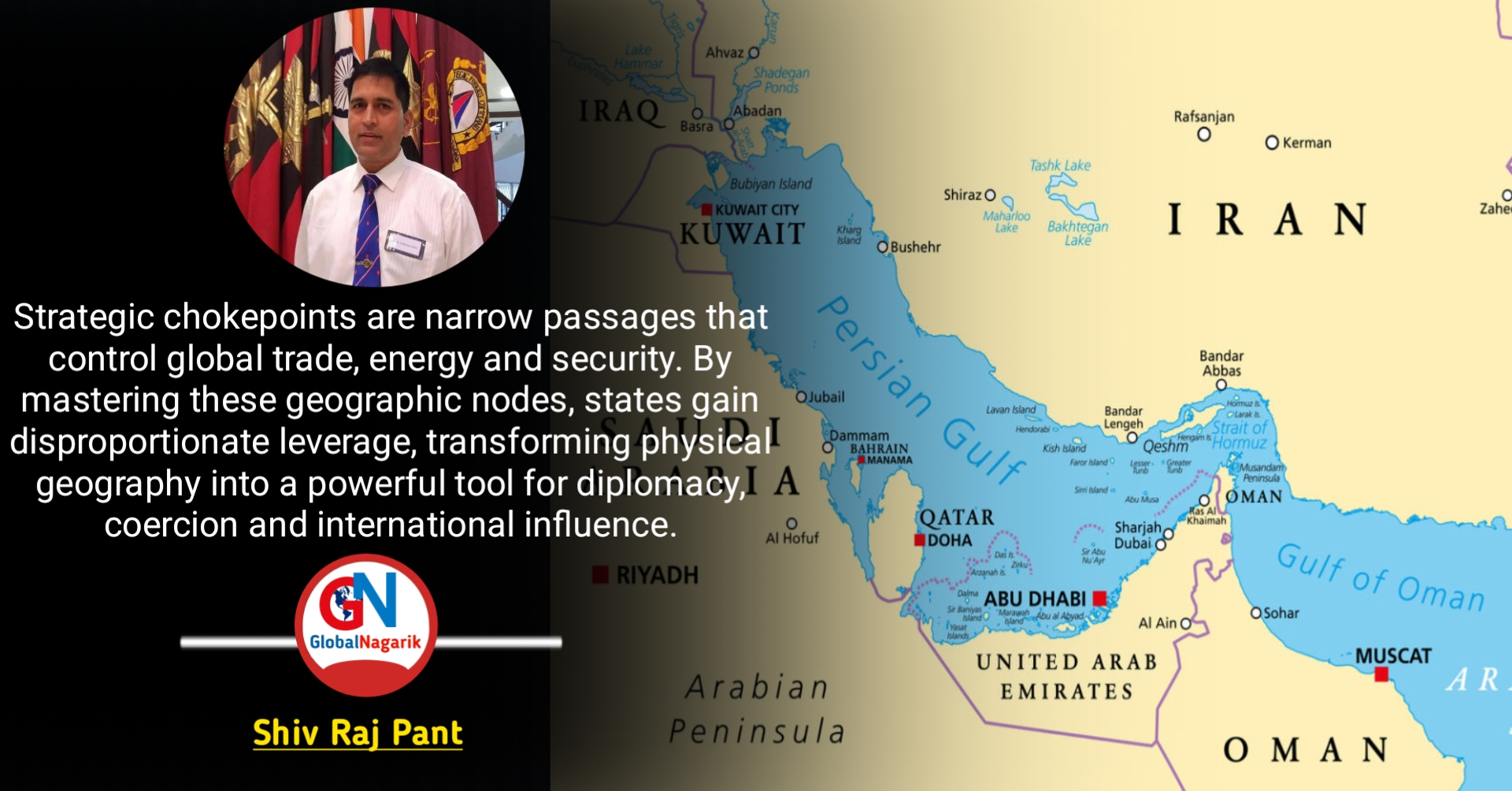
Strategic chokepoints, narrow passages in land or sea, hold a disproportionately significant role in global politics as they shape trade, energy security, and diplomatic influence. From historical examples such as Thermopylae and Constantinople to modern maritime corridors like the Strait of Hormuz and the Strait of Malacca, control over these locations allows states to project power beyond conventional military capability. Chokepoints offer both opportunities and vulnerabilities. For landlocked states like Nepal, strategic positioning and regional connectivity provide alternative means to harness geographic relevance. In an increasingly interconnected world, chokepoints remain central to understanding how geography translates into strategy and power.
– Shiv Raj Pant
In international affairs, power is often measured through economic capacity, military capability, and diplomatic reach. Yet one of the most consistent and often underestimated foundations of power lies in geography. Certain locations on the global map possess an importance that far exceeds their size. These are strategic chokepoints and vital grounds, where control over a limited physical space allows influence over expansive systems of trade, energy, and security.
A defining example is the Strait of Hormuz; a narrow maritime corridor located between Iran and Oman. A significant portion of global oil shipments moves through this passage, making it one of the most strategically sensitive routes in the world. Comparable importance is seen in the Suez Canal, the Strait of Malacca, and the Panama Canal, each functioning as a critical artery in the global economic system.
From an international relations perspective, chokepoints highlight the continued relevance of both realist and geo-economic approaches. Realism underscores the pursuit of power, control, and survival in an uncertain system, while geo-economics emphasizes how economic flows and dependencies shape strategic behavior. Chokepoints operate at the intersection of these frameworks. They are not merely physical passages but strategic assets that enable states to influence global markets, constrain adversaries, and reshape bargaining dynamics. In this sense, geography becomes a subtle yet powerful instrument of influence.
Chokepoints share a set of defining characteristics that give them enduring strategic value. They are geographically narrow, which channels movement into confined routes. They concentrate large volumes of trade or energy flows into a single pathway. They often lack viable alternatives, making rerouting difficult and costly. They are highly vulnerable to disruption, where even limited interference can produce global consequences. They are also subject to control by nearby actors, enabling monitoring, regulation, or coercion. Together, these features transform chokepoints into instruments of both leverage and vulnerability.
Historical experience reinforces the significance of such locations. In ancient times, the Battle of Thermopylae demonstrated how terrain could shape military outcomes. A smaller defending force was able to delay a much larger invading army by exploiting the constraints of a narrow passage. This principle has echoed across centuries, reminding strategists that geography can offset disparities in power.
In later eras, control over strategic routes became central to imperial expansion and economic dominance. The fall of Constantinople reshaped trade connections between Europe and Asia, illustrating how a single geographic point could alter global economic patterns. During the World War II, maritime chokepoints such as the Strait of Gibraltar and the Suez Canal were essential for sustaining military logistics and operational reach. Control over these routes directly influenced the ability of states to maintain war efforts.
The Suez Crisis further demonstrated the political weight of chokepoints. When Egypt asserted authority over the canal, it triggered a major international confrontation, revealing how control over a narrow passage could challenge established power structures and reshape diplomatic alignments.
Recent developments have once again illustrated how chokepoints function as active instruments of strategy rather than passive geographic features. During heightened tensions between the United States and Iran in 2026, the Strait of Hormuz emerged as a central variable in strategic bargaining. IranÔÇÖs geographic position enabled it to signal the potential disruption of a critical global energy route, immediately affecting oil markets and raising the stakes for all involved actors.
This positioning translated into tangible diplomatic outcomes. The temporary easing of tensions, reflected in a two-week ceasefire, was closely linked to the reopening of the Strait of Hormuz. Both sides recognized that prolonged disruption would impose significant economic costs not only on the parties involved but also on the broader international system. This episode demonstrated a core principle of international relations: when conventional military balance is uneven, control over strategic geography can generate alternative forms of leverage.
From the perspective of bargaining theory, this reflects the logic of asymmetric power. A state that may be comparatively weaker in conventional terms can still influence outcomes by controlling a critical node in global systems. By creating uncertainty and potential cost escalation, it shifts negotiations into a broader strategic domain that includes economic stability, alliance pressures, and global market reactions. In this way, chokepoints become tools of coercive diplomacy.
At the same time, major powers remain deeply committed to ensuring the security of these routes. The continued deployment of forces such as the United States Navy in key maritime corridors reflects a longstanding emphasis on maintaining open access and stability. This is not only a matter of security but also a necessity for sustaining global economic flows.
The Strait of Malacca offers another illustration of how chokepoints shape long-term strategic planning. It serves as a critical link between major economic regions and supports the energy and trade requirements of countries such as China and Japan. Concerns about its vulnerability have encouraged diversification of supply routes and investments in alternative connectivity, demonstrating how dependence on chokepoints drives broader strategic adjustments.
Despite their advantages, chokepoints also introduce inherent risks. Their concentration of flows makes them highly susceptible to disruption, whether through conflict, accidents, or non-state actors. A single incident can interrupt supply chains and generate ripple effects across the global economy. This dual nature, as both a source of leverage and a point of vulnerability, places chokepoints at the center of contemporary strategic thinking.
The concept is also evolving beyond traditional physical geography. In the modern era, digital infrastructure such as undersea communication cables and satellite systems functions as critical pathways for information. Disruptions in these networks can have consequences comparable to those seen in maritime chokepoints, reinforcing the broader principle that control over key routes translates into influence.
For countries like Nepal, the relevance of chokepoints lies in strategic positioning rather than direct control of maritime corridors. By developing transit routes, enhancing connectivity, and positioning themselves within regional networks, such states can create their own forms of strategic importance. This reflects a broader shift in understanding, where geography is not only inherited but can also be strategically utilized.
As the world becomes more interconnected, the importance of these strategic passages will only grow. Energy transitions, shifting trade patterns, and emerging technologies may alter the map, but they will not eliminate the underlying logic. Geography will continue to matter, and in certain places, it will matter disproportionately.
In the end, chokepoints are where geography becomes strategy, and strategy becomes power.
Author: A retired senior military officer and a scholar of International Relations and Diplomacy with advanced degrees in Strategic Studies, Resource Strategy, Strategic Leadership and Defense Studies from leading international institutions.
Publish Date: April 8, 2026







Feedback