
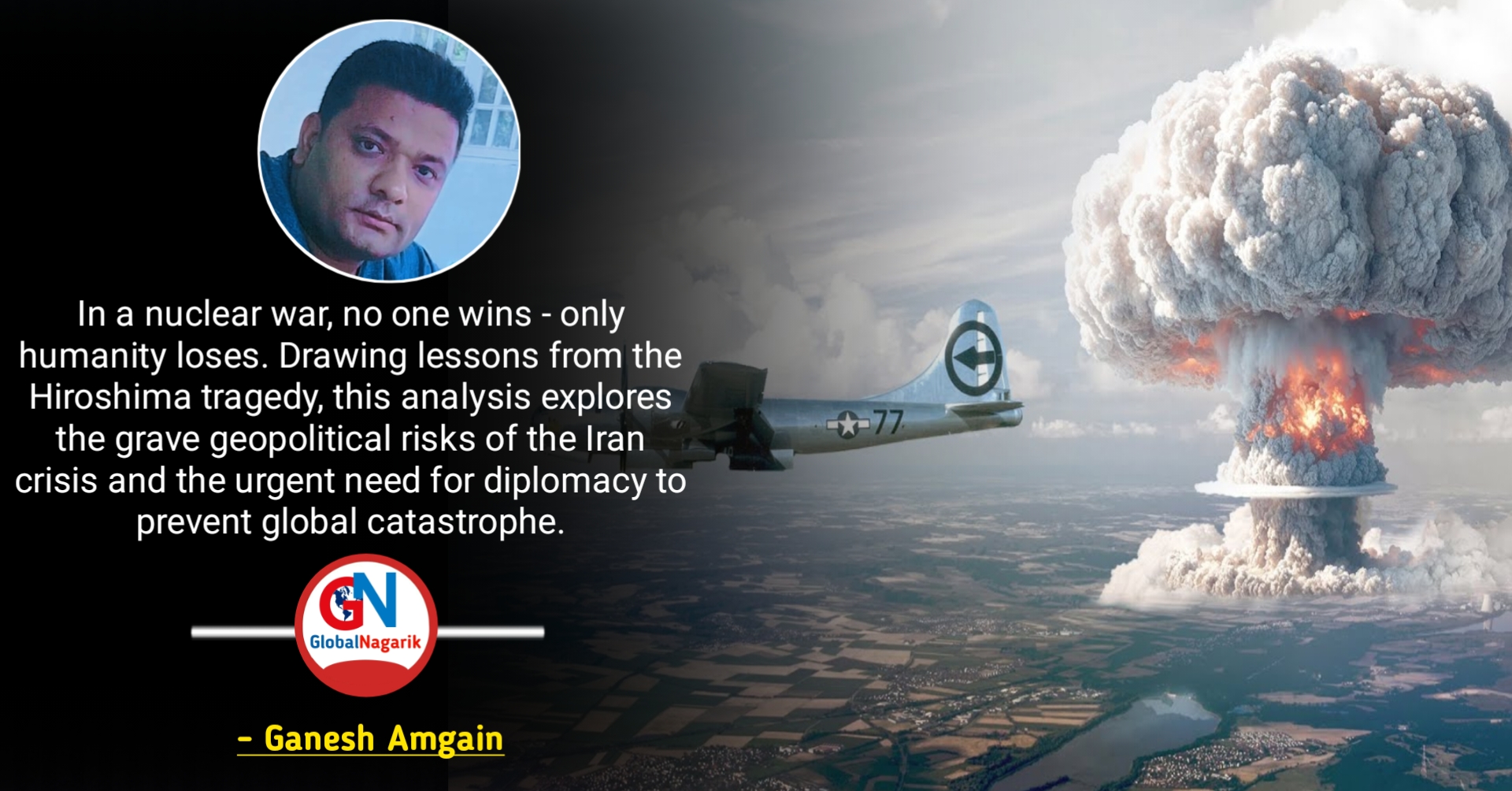
The morning of August 6, 1945, was as calm and golden as any other day for the city of Hiroshima, Japan. People were busy with their daily routines – some heading to offices, others attending to household chores, while children awaited the first school bell. But at exactly 8:15 AM, a death fell from the sky that divided human history into two parts forever. The deployment of the atomic bomb ‘Little Boy’ by the American Boeing B-29 aircraft marked the beginning of the most horrific moment in history. The bomb detonated in mid-air before hitting the ground, generating a temperature of nearly 4,000┬░C. In an instant, the city of Hiroshima turned into a ball of fire, and approximately 80,000 people were killed immediately. Those at the epicenter evaporated so rapidly that only the “shadows” of their bodies remained etched onto stones. This was not just a bomb; it was the cruelest monster ever created by science against humanity.
The seeds of this tragedy were sown in 1939 after Hitler invaded Poland. During that fierce period of World War II, the world was divided into two factions – the ‘Axis Powers’ including Nazi Germany, Italy, and Imperial Japan, and the ‘Allied Powers’ including Britain, the Soviet Union, and the United States. Initially, the U.S. did not want to be directly involved, but after JapanÔÇÖs sudden attack on the Pearl Harbor naval base in 1941, America was forced into the war. At that time, JapanÔÇÖs military strength and arrogance were at their peak. Emperor Hirohito was regarded as a god by his people, and blind obedience to his orders was considered the ultimate religion. This radical nationalism and expansionist mindset pushed Japan to a point where retreat was viewed as a total humiliation. Ultimately, this stubbornness forced millions of innocent citizens to pay an unimaginable price for the ambitions of their rulers.
In the Japanese army, a distorted interpretation of the ‘Bushido’ tradition taught soldiers that choosing death over surrender was the greatest honor. This resulted in the birth of ‘Kamikaze’ pilots, who sacrificed themselves by crashing their explosive-laden aircraft directly into enemy ships. Even as the possibility of winning the war faded, Japan refused to accept defeat. The U.S. had halted oil and steel exports to weaken Japan economically, in retaliation for which Japan planned to seize oil fields in Southeast Asia. Since those areas were controlled by the British and the Dutch, Japan saw no option but a direct confrontation with the U.S. The stubbornness and blind nationalism of the Japanese leadership created a situation where millions of civilians faced unimaginable catastrophe. For America, this had become a battle of prestige and power, where strategic victory outweighed sympathy.
By the beginning of 1945, Germany had surrendered and Hitler had committed suicide, but Japan continued to fight alone. The U.S. had planned a ground-based invasion called ‘Operation Downfall’ to fully capture Japan. However, the fierce battle on the island of Okinawa startled American commanders. Approximately 12,000 American soldiers were killed there, while over 100,000 Japanese civilians and soldiers lost their lives. President Harry Truman feared that if such a small island caused this much damage, an invasion of the Japanese mainland would result in the deaths of millions of American soldiers. Meanwhile, the secret ‘Manhattan Project’ had successfully tested the atomic bomb. Truman saw this bomb as an infallible way to end the war quickly and save the lives of his troops. This fatal decision was made in the name of military strategy, rising above morality and human sensitivity.
In July 1945, the U.S. gave Japan a final warning to surrender unconditionally through the ‘Potsdam Declaration.’ After Japan ignored the warning, Hiroshima was destroyed on August 6. Even after such massive destruction, some hardliners in the Japanese military were not ready to give up. Their persistence led the U.S. to drop the second atomic bomb, ‘Fat Man,’ on Nagasaki on August 9, 1945. Although the damage in Nagasaki was slightly less due to its hilly geography compared to Hiroshima, the scene was equally gruesome. The ‘Black Rain’ that fell after the explosion was so toxic that it caused severe radiation sickness in the survivors. People were desperate with thirst, but the water had become poison. Hospitals were destroyed and doctors themselves were killed, leaving no one to treat the injured. This forced Japan to its knees and showed the world the dark side of nuclear power.
In addition to the atomic bombings, the Soviet Union declared war on Japan and began an invasion of Manchuria. Faced with the double blow of atomic bombs and the increasing pressure of the Soviet army, Emperor Hirohito finally announced surrender over the radio on August 15, 1945. This announcement marked the formal end of World War II. For the next seven years, the Allied forces occupied Japan and implemented a new democratic constitution. The Emperor was kept in office but was limited to a ‘symbolic head’ with no real power. The way Japan rebuilt itself from the ashes is a great example for the world today. However, the deep wounds of Hiroshima and Nagasaki remain alive in the Japanese psyche, constantly reminding us of the disastrous consequences of power and ego. This history teaches us that when a superpower feels it has no alternatives, it may choose a path of destruction that puts all of humanity at stake.
Of the approximately 200,000 people killed in Hiroshima and Nagasaki, more than 95% were ordinary citizens with no direct connection to the war. The survivors are known as ‘Hibakusha,’ who faced a lifetime of cancer, disability, and social discrimination. Due to the effects of radiation, many children were born with physical and mental impairments. Even today, the Hiroshima Peace Memorial Park reminds the world of the horrors of nuclear weapons. The debate over whether the U.S. was right or wrong to use the bomb continues to this day. Many Americans consider it a necessary step to save their soldiers and protect national prestige, while the Japanese and human rights activists view it as a major war crime and an act of cruelty against humanity. It is an undeniable truth that the explosion left an indelible stain on the morality of human civilization.
The use of nuclear weapons terrified the world so much that for more than 75 years, no country has dared to use them in war. This event led to the development of the concept of ‘Nuclear Deterrence’, which means that if one party uses them, the other will retaliate, and the entire world will be destroyed. During the Cold War, although the risk of nuclear war between the U.S. and the Soviet Union increased several times, the memory of Hiroshima held them back. Today, many countries possess nuclear bombs thousands of times more powerful, but they are kept only as a psychological deterrent. The pain of Japan has taught the world a lesson: in a nuclear war, no one wins; it is only a defeat for human civilization. But does this lesson apply to Iran? Today’s geopolitics revolves around this very nuclear fear.
In the current context, IranÔÇÖs nuclear program has become the biggest headache in global politics. Just like in 1945, the U.S. and Israel are making every effort to prevent Iran from becoming a nuclear-armed nation. If Iran succeeds in building a nuclear bomb, it will directly challenge the existence of Israel and American dominance in the Middle East. For the U.S., this has become a matter of prestige to protect its image as the ‘world’s policeman.’ If diplomacy fails and Iran reaches the ‘breakthrough point’ of weapon construction, there is a strong possibility that the U.S. will conduct a ‘Pre-emptive Strike’ for its security and that of its allies. The radical leadership of Iran and Israel’s security concerns could spiral out of control at any time. If the U.S. fails to stop Iran, its credibility in international politics will crumble.
Will another nuclear tragedy be repeated in Iran? Analyzing the situation, if Iran launches a major attack on Israel or causes irreparable damage to American interests, the U.S. may use destructive military force that is ‘equivalent to nuclear’ even if it is not a nuclear bomb itself. Unlike the Japan of 1945, Iran is not alone today; it has the silent or open support of powers like Russia and China. However, if Iran insists on building weapons and the U.S. feels it has no other choice, the fear of history repeating itself always remains. Although the possibility of a nuclear strike is low because the today’s world is economically interconnected and fears ‘Mutual Destruction,’ a potential Israeli or American attack on Iran could once again bring the world to the brink of mass destruction. History warns us that when power and arrogance overshadow diplomacy, humanity may face another darkness like Hiroshima. Diplomacy remains the final and best option to prevent this potential carnage.
Publish Date: March 31, 2026








Feedback