
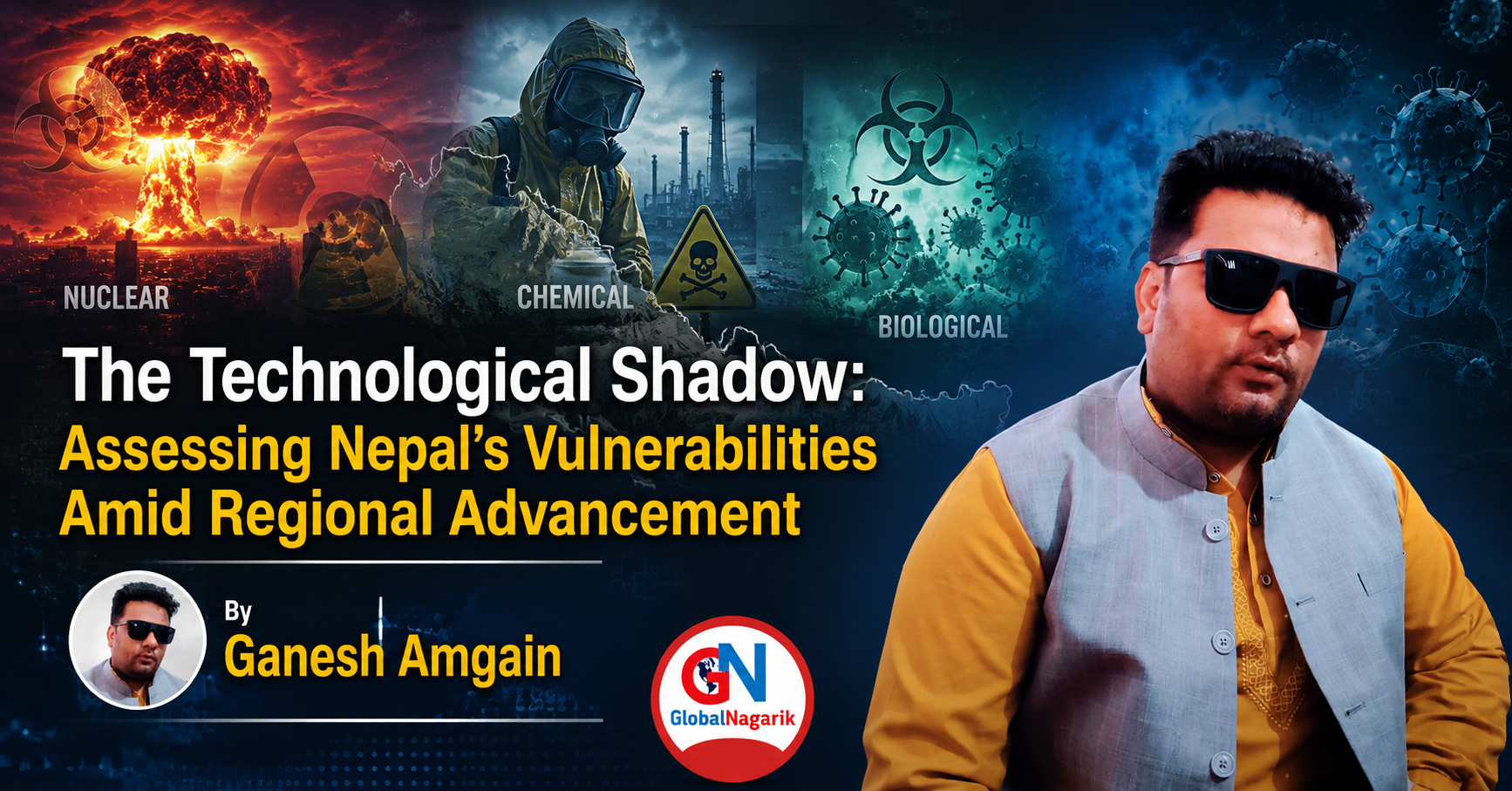
The neighboring nations of India, China, and Pakistan are rapidly developing and deploying nuclear, chemical, and biological technologies. These countries are utilizing these sensitive technologies extensively – not only for military defense but also in scientific research, healthcare, energy production, industrial expansion, and the agricultural sector. Situated right at the center of this triangular nuclear and technological competition, Nepal, due to its geographical vulnerability, naturally finds itself susceptible to the risks generated by this rivalry. Small and large-scale nuclear activities, industrial accidents, or biological experiments occurring in the neighborhood are directly impacting Nepal’s atmosphere, water resources, and overall environment.
Nepal itself is a peace-loving nation that possesses no weapons of mass destruction or large nuclear reactors. Nevertheless, Nepal cannot remain entirely immune to the invisible radiation emitted from scientific testing, satellite launches, and nuclear power plants conducted by neighboring countries. In the present era, the chemical and industrial revolutions taking place under the guise of science and technology have crossed borders, adding serious challenges to the health of Nepali citizens. Chemical industries established in border areas and the rising air pollution from both the south and the north have put Nepal’s ecosystem into a state of crisis.
Looking from a futuristic perspective, this risk is bound to become even more terrifying and complex. Potential military confrontations between neighboring nations, technological accidents in nuclear reactors, or leaks of deadly viruses and bacteria from laboratories could cause irreparable damage to Nepal. Experiments conducted against the laws of nature in the name of scientific development risk raising huge question marks over Nepal’s Himalayan region, biodiversity, and human existence in the days to come. Therefore, understanding this multidimensional crisis and strengthening internal preparedness alongside international diplomacy has become Nepal’s immediate necessity.
Transboundary Nuclear Risks and Environmental Degradation
The rapidly expanding nuclear power plants and nuclear research centers in neighboring countries have become an invisible threat to Nepal’s environment. Radioactive materials emitted from nuclear reactors operating in the northern region of India and around the Tibetan Plateau of China accumulate in the upper layers of the atmosphere. These invisible radiations travel with air currents to Nepal’s skies and pollute the environment here. Even without a direct nuclear explosion, the daily operation of these reactors and weaknesses in the long-term management of nuclear waste are polluting the environment of the entire South Asian region.
The greatest and most direct impact of this nuclear technology is visible on Nepal’s mountains and water resources. Due to the excessive use of nuclear energy plants and industrial coal, ‘black carbon’ or dark particles are accumulating in the Himalayan region via the atmosphere. As a result, the snow’s heat-absorbing capacity has increased, causing our mountain ranges to melt at a rapid pace. While the melting of glaciers has heightened the risk of Glacial Lake Outburst Floods (GLOFs) on one hand, it has dried up water sources in Nepal’s perennial rivers and increased the cycle of floods and soil erosion in downstream areas on the other.
When radioactive radiation and nuclear particles fall to the ground through rainfall, the natural quality of the soil degrades. As an agricultural country, when such particles mix into Nepal’s fertile land, the acidity of the soil increases, weakening its natural productive capacity. Due to chemical reactions, useful indigenous bacteria found in the soil are being destroyed. This has led to a decline in agricultural production and created a serious crisis in food security, directly impacting the country’s economy and livelihoods.
The impact of nuclear radiation and pollution has also become clearly visible in the areas of forests and vegetation. Nepal’s precious herbs, natural vegetation, and the habitats of rare wildlife are in jeopardy due to this environmental imbalance. Some sensitive plant species even face the risk of drying up prematurely or undergoing changes in their genetic structure. In Nepal, which is considered rich in biodiversity, the disappearance of indigenous species and the growing menace of invasive species from forest areas are heavily driven by the environmental air pollution of the neighboring region.
In the future, if a technological error or natural disaster causes an accident in the nuclear centers of neighboring countries, its radioactive cloud could reach Nepal’s sky within a few hours. If a nuclear accident like Chernobyl or Fukushima occurs in the neighborhood, Nepal’s entire environment could remain toxic for decades. This radiation, spreading through air and water, will permanently pollute Nepal’s forests, rivers, lakes, and mountains – the remediation of which will not be possible with Nepal’s current technological and economic capacity.
Industrial Spillover and Nepal’s Public Health Emergency
India and China are among the world’s largest chemical and industrial hubs, with factories operating close to Nepal’s border areas. Toxic gases emitted from these industries, such as sulfur dioxide, nitrogen oxide, and carbon monoxide, easily spread to the Terai and hilly regions of Nepal due to wind patterns. Not only Nepal’s industrial and urban areas, but even rural localities have fallen victim to this neighboring chemical smoke. Because of this, Nepal’s Air Quality Index (AQI) frequently reaches the world’s most hazardous levels, triggering a severe crisis in public health.
The direct blow of this chemical pollution has fallen upon the respiratory systems of Nepali citizens. The number of patients suffering from asthma, chronic cough, bronchitis, and lung cancer is increasing unnaturally day by day in Nepal. Young children and the elderly are the most severely affected by this toxic air. Ultrafine particulate matter floating in the atmosphere enters human lungs and penetrates the bloodstream, causing fatal health issues like heart attacks and strokes to appear at an early age.
When chemical waste and toxic water discharged from industries are mixed into rivers, the aquatic system becomes entirely polluted. High levels of chemicals and heavy metals (such as lead, mercury, and arsenic) have been found in the rivers. Consuming this polluted water and eating crops irrigated by it has led to a surge in kidney diseases, liver failure, and stomach-related cancers among people. As these chemicals accumulate in aquatic organisms, particularly fish, the entire food chain has become toxic.
The haphazard use of artificial chemicals and pesticides deployed during scientific and industrial research has triggered massive reproductive health issues. Pregnant women exposed to chemical pollution are facing increased instances of miscarriages or giving birth to infants with congenital disabilities. Scientific hazards indicate that chemical pollution can bring negative alterations directly into the human genetic structure (DNA). This poses a severe risk of making future generations physically and mentally weak.
In the future, major explosions or gas leaks that could occur in border areas due to the excessive storage and use of industrial chemicals could cause widespread mortality inside Nepal’s borders. If an accident similar in nature to the past Bhopal Gas Tragedy occurs near the border, thousands of people in border Nepali towns could instantly fall victim to blindness, respiratory failure, and premature death. Nepal’s hospitals and healthcare system face a severe shortage of necessary equipment, medicines, and human resources required to cope with such a chemical emergency.
The Biosafety Dilemma: Assessing Regional Biological Hazards
Advanced biological laboratories are operational in China, India, and Pakistan for the development of modern medical science and agricultural technology. Genetic modification and scientific testing of various deadly viruses, bacteria, and microorganisms are continuously carried out in these laboratories. Although such experiments are necessary for scientific research and vaccine development, the risk of virus or bacteria leaks from these laboratories always remains high. Even a minor disruption in biosafety protocols can yield consequences that are fatal globally, and particularly for neighboring countries.
Due to its open border, Nepal often becomes the first victim of virus leaks from biological laboratories or newly emerging infectious diseases that develop naturally. Driven by high population density, rapid urbanization, and biological experiments in neighboring countries, the evolution of zoonotic (animal-to-human) diseases is occurring at a rapid pace. The Corona pandemic (COVID-19) is the biggest example of this, which spread from the neighborhood and completely shattered Nepal’s healthcare system, economy, and social life. It is impossible to halt such invisible biological agents by deploying security cordons at the border.
Biological experiments in agricultural and medical sciences have created a new crisis of antibiotic resistance. Powerful bacteria have evolved due to the biological medicines and chemicals used in animal husbandry and agriculture, rendering them resistant to any currently available antibiotics. These ‘superbugs’ are entering Nepal through air, water, and migratory birds. Consequently, a terrifying situation is brewing where even common ailments like diarrhea, pneumonia, or tuberculosis might become untreatable and take the form of an epidemic in the future.
Biological experiments in agriculture and crop science, along with the use of Genetically Modified Organisms (GMO) seeds, have pushed Nepal’s traditional agriculture into a crisis. Modified seeds and biological pesticides entering from the neighborhood are permanently destroying Nepal’s indigenous seed varieties. This has not only led to a loss of Nepal’s biodiversity but has also increased the outbreak of new crop diseases and pests. These new species of pests cannot be controlled using indigenous remedies or traditional techniques, thereby threatening food security.
The greatest future biological risk is the potential biological warfare or the use of biological weapons between neighboring countries. During wartime, or if deadly biological agents (such as anthrax, smallpox, or new variants of SARS) fall into the hands of terrorist groups, it could trigger pandemics across vast territories. Due to Nepal’s fragile health surveillance system and open borders, the biological impacts of such weapons can easily spill over into Nepal. This possesses the capacity to infect a large majority of Nepal’s population within a few days, causing massive human casualties.
Navigating the Unseen Frontiers of Emerging Technological Risks
Neighboring nations are making unprecedented scientific progress in space technology, satellite launches, electronics, and heavy industries. However, managing the e-waste (electronic waste), metallic remnants, and chemical byproducts generated by this technological development has become a global challenge. Old electronic devices and batteries used and discarded in these countries, or entering Nepal through informal channels, are polluting Nepal’s landfill sites and riverbanks. Elements like cadmium and lithium leaking from this waste are contaminating the soil and underground water resources.
‘Cloud seeding’ (artificial rain) and other atmospheric scientific experiments conducted by neighboring countries for weather modification have disrupted Nepal’s natural weather cycle. Such experiments carried out in the upper layers of the atmosphere have caused sudden occurrences of extreme rainfall (cloudbursts), droughts, or unseasonal rains in Nepal. As the rhythm of the natural monsoon breaks down, instances of massive landslides in Nepal’s hilly terrains and inundation in the Terai have surged. Nepali farmers and ordinary citizens are forced to pay the price of this experimental science with their lives and property.
An additional internal risk has been introduced due to the improper management of hospital waste arising from radioactive equipment used in medical science, X-rays, CT scans, and cancer treatments. Imitating neighboring technology, such equipment has entered Nepal as well, but Nepal lacks the technology for its safe disposal. Such radioactive and biological waste from hospitals is often discharged directly into public drains or rivers. This directly exposes urban citizens and sanitation workers to hazardous radiation and infections.
Another facet of scientific technology involves geological experiments carried out for large infrastructure construction. Large dams, tunnels, and underground mines being built by China and India near Nepal’s borders have weakened the geological stability of the Himalayan region. Due to these heavy vibrations and excavations, small and large tremors and land subsidence have started appearing in the hilly terrain of Nepal, which possesses a weak geological structure. The possibility of this triggering a massive earthquake in Nepal in the future cannot be ruled out, threatening Nepal’s very physical existence.
In the future, technological anomalies in chemical or nuclear mechanisms based on Artificial Intelligence (AI) and automated systems present another grave threat. If a cyber-attack or software failure occurs in the automated systems of neighboring countries, nuclear or chemical waste could be released uncontrollably into shared rivers. In such a scenario, Nepal’s water resources will become completely toxic. This uncontrolled race of science appears poised to leave Nepal permanently dependent, technologically weak, and vulnerable to suffering punishments for the mistakes of other nations.
The Way Forward with Strategic Diplomacy and Internal Readiness
Even though Nepal does not participate in the race for nuclear, chemical, or biological weapons and grand technologies, it is forced to bear their multidimensional risks due to its geopolitical positioning. It is already clear that the rapid scientific and industrial development of neighboring nations is causing long-term and irreparable damage to Nepal’s environment, Himalayas, water resources, and public health. Invisibly spreading radioactive radiation, industrial chemicals, and biological pandemic pathogens are silent yet deadly crises for Nepal. This risk is a sensitive matter tied not only to the present generation but also to the future of upcoming generations and national sovereignty.
To protect itself from this complex situation, Nepal must immediately adopt multidimensional and long-term strategies. First and foremost, ‘Radioactive and Chemical Radiation Measurement Centers’ and modern ‘Biosafety Surveillance Laboratories’ must be established across all border checkpoints and major urban areas. A warning system must be developed by continuously monitoring air and water quality to detect potential hazards. The National Disaster Risk Reduction and Management Authority (NDRRMA) must be empowered with specialized training, advanced equipment, and antidotes capable of tackling nuclear and chemical catastrophes.
At the international level, Nepal has no alternative but to take strong diplomatic initiatives by leveraging its neutral and peace-loving identity. Accountability regarding the environmental standards of industries in border areas and nuclear safety must be demanded through bilateral and multilateral dialogues with India, China, and Pakistan. In forums like the United Nations and the International Atomic Energy Agency (IAEA), Nepal must raise its voice against environmental injustice from its standpoint as a downstream and Himalayan nation. Intensifying internal preparedness while adopting a resolute diplomatic strategy to protect the health of its citizens and nature is the paramount need of today for Nepal.
(The author is a former military officer of the Nepal Army and a scholar of Political Science.)
Publish Date: June 26, 2026








Feedback