
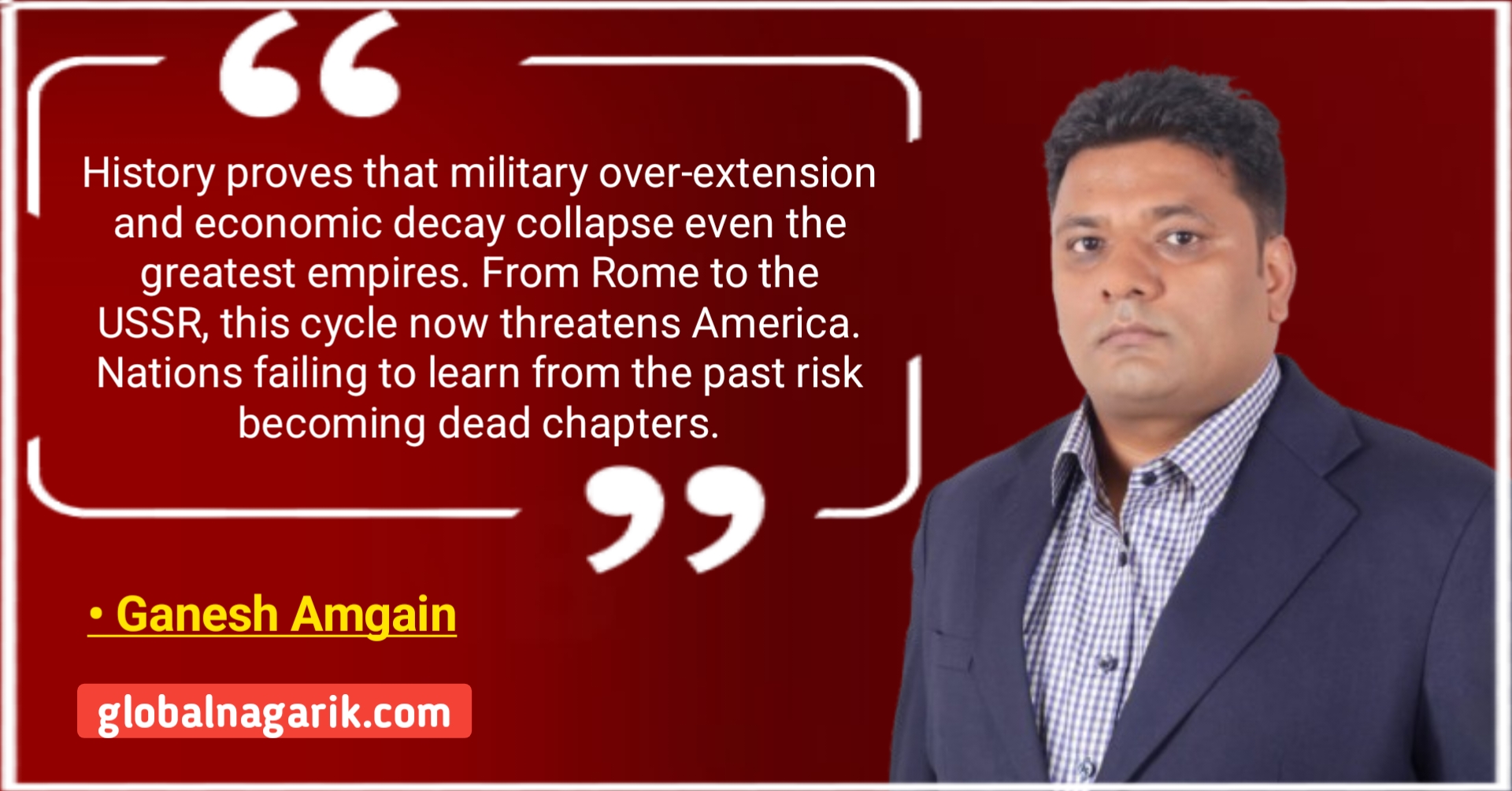
History reveals an unalterable truth: every empire or superpower has a defined lifespan and a cyclical nature. From the ancient Roman and Ottoman Empires to the major powers since the 15th century – such as Spain (1500 – 1700), Britain (1800 – 1945), and the Soviet Union (1922 – 1991) – a consistent and alarming pattern emerges. These powers initially ascend through innovation, the discovery of new trade routes, and military fortitude. However, they eventually plunge into decline due to excessive military burdens and economic mismanagement. Today, the United States (1945 – Present) appears to be walking the exact same path that relegated past superpowers to the pages of history. History has repeatedly proven that no nation can endure forever solely on the strength of its military. Those who fail to learn from history inevitably become part of its wreckage.
The first and primary stage of imperial decline is the obsession with military expansion, known as ‘military over-extension.’ At its peak, the Roman Empire occupied a vast territory from Britain to Iraq, but the cost of maintaining the legions and communication lines eventually crippled its economy. In the 16th century, Spain spread its forces across Europe, the Americas, and the Philippines, while the British Empire famously claimed that “the sun never sets” on its domains. Similarly, the Soviet Union hollowed out its internal foundations by spending over 20% of its GDP on the military during the Cold War. Currently, the U.S. operates over 750 military bases in more than 80 countries, spending over $850 billion annually. When military spending exceeds a nationÔÇÖs sustainable income, investment in basic needs, education, and infrastructure inevitably drops, making the weight of the empire impossible to bear.
The second major cause of decline is the misallocation of resources and investment in unproductive sectors. In its final days, the Ottoman Empire spent unlimited wealth on grand, expensive palaces and the luxurious lifestyles of the Sultans, even as the Industrial Revolution was transforming Europe. Spain squandered tons of gold and silver from South America on religious wars and regional European conflicts instead of national industrial development. Likewise, the Soviet investment in Afghanistan from 1979 to 1989 caused irreparable damage to its economy. The United States has also spent nearly $8 trillion on wars in the Middle East over the past two decades. Such expenditures do not generate long-term production; they simply drain the national treasury and trap the economy in a deep quagmire of debt. When a nation abandons technology and production for mere military dominance, its global competitiveness vanishes.
Currency debasement is another terrifying sign of decline; a tactic used since ancient Rome. The Roman ‘denarius’ initially contained 100% silver, but as expenses mounted, emperors gradually mixed it with copper until only 0.5% silver remained, causing catastrophic inflation. Spain similarly introduced the ‘Vellon’ – a weakened currency mixed with copper – in the 17th century to fund its debts. Since the U.S. decoupled the dollar from the Gold Standard in 1971, its purchasing power has plummeted by 98%. Particularly after 2020, the U.S. printed over $7 trillion at its own whim, dealing a massive blow to global confidence in the dollar. The fall of a currencyÔÇÖs value represents the erosion of both the nationÔÇÖs credit and its global power.
Debt eventually suffocates any superpower. Even at the height of its power, Spain was officially declared bankrupt four times between 1557 and 1596. Britain, unable to repay the massive debts incurred during World War II, was forced to relinquish its prized colonies after 1947. In the 19th century, the Ottoman Empire had to hand over its customs and tax systems to foreign powers because it could not repay loans from European banks. Today, the U.S. faces a national debt exceeding $39 trillion, which is more than 124% of its GDP. This creates a dangerous cycle were new, larger loans must be taken just to pay the interest on old ones. This mountain of debt acts as a financial volcano that could erupt at any moment, ending its status as a superpower.
A decline in productive capacity marks another grave stage of collapse. In the 16th century, Spain began importing everything using South American gold and silver, causing its internal production and skills to vanish. The Ottoman Empire also failed to compete with European industrial output, becoming a mere exporter of raw materials. Although Britain led the Industrial Revolution, its decline began when the U.S. and Germany surpassed it in production. Today, the U.S. relies on supply chains from China and other Asian nations for everything from medicine to electronics and military parts. With an annual trade deficit exceeding $800 billion, a nation that lacks domestic production and innovation cannot lead the worldÔÇÖs economy for long. Like Spain, “import-based prosperity” is fragile and unsustainable.
Social decay and a loss of trust in institutions weaken a nation from within. Before Rome fell, its citizens lost their sense of duty, and rulers distracted the public with “bread and circuses.” In the final years of the Soviet Union, corruption and public hatred for the regime reached their peak. Similarly, during Spain’s decline, skilled laborers and scholars fled the country. In the U.S., the fentanyl crisis, the rise in homelessness, and minimal public trust in government institutions (courts, media, parliament) indicate a fraying social fabric. When a society becomes morally and socially divided, and citizens prioritize personal or partisan interests over the national good, the nation begins to collapse internally long before an external enemy strikes.
Changing behavior among allies and rising morale among rivals signal the nearing end of an empire. In the 19th century, the Ottoman Empire was called the “Sick Man of Europe” because neighbors began seizing its territories as soon as they sensed its weakness. Before the fall of the USSR, its Eastern European allies abandoned it in favor of democracy. Britain also could not sustain its colonies post-war. Recently, when the U.S. sought support for maritime security, allies like Saudi Arabia, Japan, and Germany began adopting more independent foreign policies. Meanwhile, rivals like China, Iran, and Russia are directly challenging U.S. military and economic dominance. When the world stops fearing a superpower and seeks alternative frameworks (like BRICS), that power’s global hegemony is effectively over.
The currency crisis and the decline of the dollarÔÇÖs dominance represent the final turning point. Just as the dollar replaced the British pound, the world is now moving toward ‘de-dollarization.’ The Ottoman currency, the ‘Akce,’ lost its value, leading to a loss of trade control. Iran, China, Russia, and India have already begun conducting trade in their own currencies. If the world stops accepting the dollar as the reserve currency, the U.S. will lose the unique privilege of buying global resources by simply printing paper. A drop in dollar demand will trigger massive inflation within the U.S., causing chaos. Like the collapse of the Soviet ‘Ruble’ in the international market, the future of the dollar now faces a massive question mark.
History shows that during a decline; leadership becomes weak or highly controversial. Rome saw a succession of incompetent emperors. In the Soviet Union, Mikhail GorbachevÔÇÖs reform efforts inadvertently paved the way for dissolution. In Spain, weak successors after King Philip II could not preserve the empire. Today, the U.S. faces extreme polarization regarding leadership. Policies from leaders like Trump or Biden are often analyzed as having weakened global alliances and fueled internal divisions. When leadership cannot unite a nation, the fall of the empire becomes inevitable. Ultimately, the end usually comes not from a great external war, but from internal economic and structural failure. If the U.S. does not implement timely reforms, it too will be limited to a dead chapter of history. As the saying goes, “History does not repeat itself, but it rhymes.”
Publish Date: March 24, 2026









Feedback