
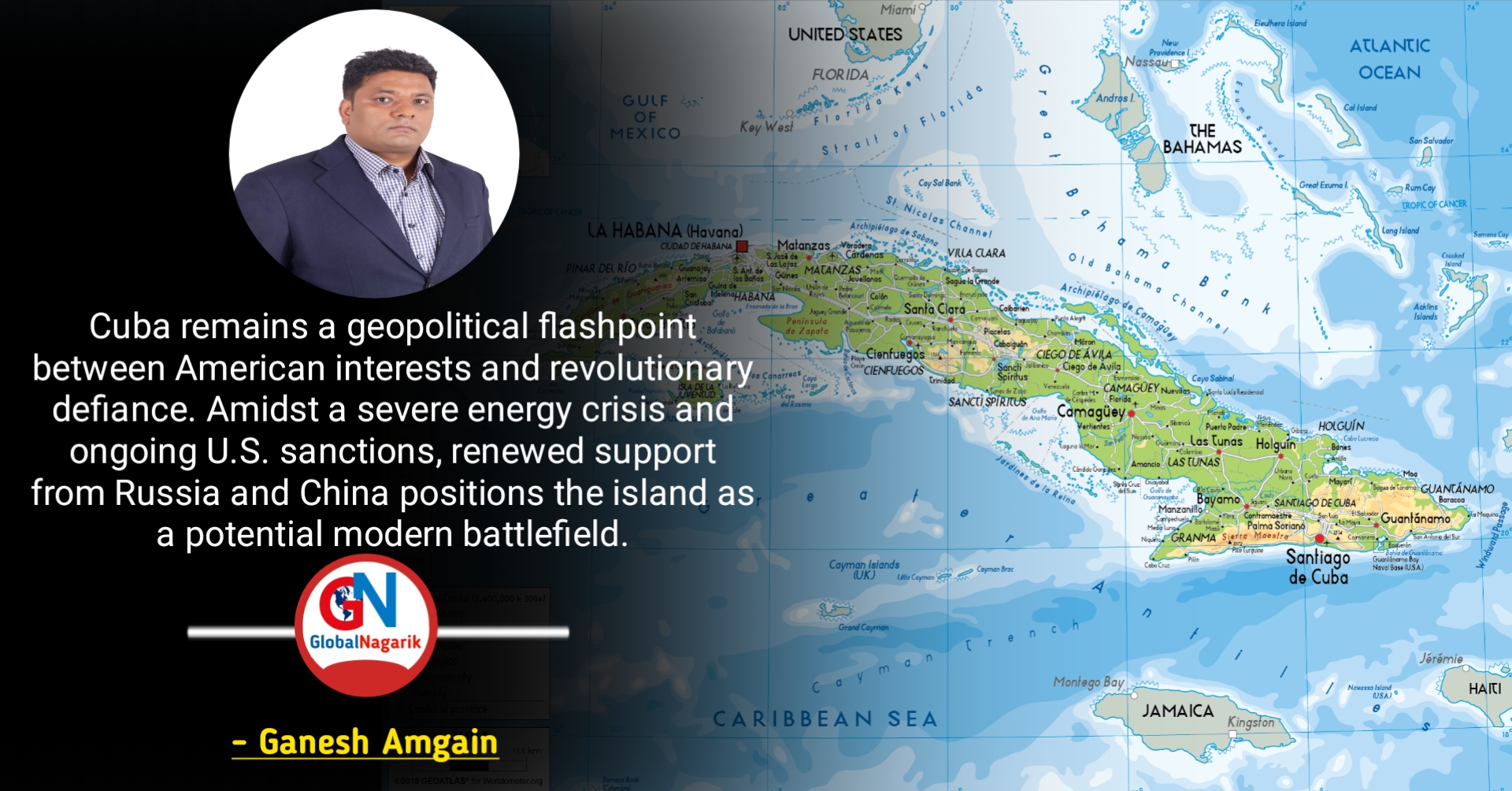
Cuba, a strategically vital island nation located just 90 miles from the coast of Florida, is the largest and most significant territory in the Caribbean. Known globally as the “Sugar Bowl of the World” due to its fertile soil and immense sugar production, this naturally stunning country is famous not only for its coffee, tobacco, and world-renowned cigars but also for a unique political history that has kept it at the center of global geopolitics. After Christopher Columbus stumbled upon the island in 1492 while searching for India, Cuba endured nearly 400 years of Spanish colonial rule. Unwilling to tolerate a European power so close to its borders, the United States incited the Cuban people to rebel and even provided weaponry. Following the Spanish-American War of 1898, Cuba finally gained independence in 1902. However, this independence came with a catch: the Platt Amendment, which granted the U.S. the right to intervene in Cuban internal affairs at any time and established a permanent naval base at Guantanamo Bay. Thus, despite its technical independence, Cuba remained shackled under the shadow of American influence for decades.
The rise of Fulgencio Batista after 1933 turned Cuba into a complete protectorate of American interests. Under Batista’s reign, Cuban sovereignty existed only on paper; in reality, the economy was controlled by the American Mafia and corporate tycoons. Productive agricultural lands, sugar mills, mines, and telecommunication services were handed over to U.S. companies for pittance. The Havana of that era was a stark contrast to the present – it served as a “planning center” for gambling, prostitution, liquor, and unbridled hedonism for the American elite. While Americans lived in luxury, the local Cuban population withered under poverty, unemployment, and extreme exploitation. It was on this foundation of injustice that the spirit of revolution ignited under the leadership of Fidel Castro. In 1959, after a prolonged guerrilla war, Castro toppled Batista. Upon taking power, Castro took a hardline stance against the U.S., announcing the nationalization of all private banks and foreign industries. This move dealt a massive economic and strategic blow to the U.S., prompting Washington to label Castro an arch-enemy and marking the beginning of a dangerous Cold War saga.
For the United States, neutralizing Fidel Castro and reinstalling a pro-American government became a matter of prestige. The CIA has a documented history of making over 638 failed assassination attempts on Castro – a world record. These plots were so bizarre and cruel they seem lifted from a movie script – ranging from exploding cigars and poisoning his favorite coffee and ice cream to more elaborate schemes. Knowing his love for diving, the CIA planned to lace his diving suit with deadly bacteria or hide explosives inside seashells. Even female spies were deployed as “honey traps,” but Castro’s security apparatus was so formidable that he survived every attempt. In 1961, the U.S. launched the Bay of Pigs invasion using trained Cuban exiles, but Castro’s forces crushed them within three days. This failure humiliated the U.S. on the world stage, leading to Operation Mongoose, a strategy designed to hollow out the Cuban economy from within and destroy its vital infrastructure.
In 1962, Cuba became the epicenter of the most terrifying moment in world history: the Cuban Missile Crisis. In response to the U.S. deploying “Jupiter” nuclear missiles in Turkey and Italy to threaten the Soviet Union, Soviet leader Nikita Khrushchev sought a counter-move in Cuba. He secretly deployed Soviet nuclear missiles on the island, from where almost every major American city could be turned to ash in an instant. When a U.S. U-2 spy plane captured images of these missiles, President John F. Kennedy was stunned. He announced a naval blockade (quarantine) of Cuba to prevent Soviet ships from reaching the island. On October 27, 1962, the world stood on the brink of nuclear annihilation when a U.S. ship dropped depth charges on a Soviet submarine. Inside the sub, the commanders, thinking war had begun, prepared to launch a nuclear torpedo. However, Commander Vasily Arkhipov refused to authorize the launch at the last second, saving humanity from destruction. Eventually, the crisis ended with a deal: the U.S. would remove its missiles from Turkey and promise not to invade Cuba, in exchange for the Soviets withdrawing their missiles.
Behind this geopolitical conflict lies a mysterious chapter of U.S.-Israel relations. President Kennedy did not want Israel to develop nuclear weapons; he wanted Israel to remain dependent on the U.S. for security to ensure American hegemony in the Middle East. He placed immense pressure on Israeli Prime Minister David Ben-Gurion to allow inspections of the Dimona nuclear facility and halt the program. Some historical analyses suggest this friction was so deep that there are even suspicions regarding the role of the Israeli intelligence agency, Mossad, in Kennedy’s 1963 assassination. After Kennedy’s death, subsequent U.S. presidents adopted a much softer policy toward Israel, allowing it to establish itself as an undeclared nuclear power. Today, the U.S. effort to stop Iran’s nuclear program is rooted in this same strategic anxiety: preventing any other nuclear power from emerging that could challenge Israeli security and American dominance in the Middle East.
In October 1962, while the two superpowers were preparing for nuclear war over Cuba, China seized the opportunity to attack India. Chairman Mao Zedong chose this moment with calculated precision, knowing that while Russia and the U.S. were occupied with Cuba, no one would be able to assist India. In this war, China seized large swaths of territory in India’s Ladakh region (Aksai Chin) and the North-East Frontier. This “opportunistic” strategy is still visible today – whenever a major global crisis erupts, China increases pressure on its borders. Currently, while the U.S. and the West are distracted by the Russia-Ukraine war and Iran-Israel tensions, China has surrounded Taiwan. If the U.S. becomes fully embroiled in a Middle Eastern war, it may provide the perfect opportunity for China to take control of Taiwan. History proves that in geopolitics, a crisis for one power is often a golden opportunity for another.
During those difficult Cold War years, India led the Non-Aligned Movement (NAM), choosing not to join any military bloc. However, while theoretically non-aligned, both India and Cuba were practically close to the Soviet Union. In 1983, during the NAM summit in Delhi, the warm embrace between Fidel Castro and Indira Gandhi sent a powerful message to the world. It reflected the unity of the “Global South” – developing nations standing against imperialist policies and colonial mindsets. Today, this spirit of unity has evolved into organizations like BRICS, where India, Russia, and China are working together to challenge the monopoly of the American dollar. The relationship between Cuba and India shows that regardless of geographical distance, shared political ideologies and a common adversary can bring nations together.
Fidel Castro governed Cuba for nearly half a century, from 1959 to 2008 – a rare record for any non-monarchical leader in modern history. During his 50-year reign, 11 U.S. presidents, from Eisenhower to George W. Bush, came and went, yet none could topple him. Castro’s greatest success was not just surviving American imperialism right under its nose but also achieving unprecedented progress in education and healthcare within Cuba. In 2008, due to failing health, he handed over power to his brother, Raul Castro. Raul governed for a decade before transferring leadership to Miguel Díaz-Canel. Thus, the Castro brothers steered Cuba under a single ideology for 60 years. In return, Cuba endured over half a century of brutal economic sanctions and isolation from the U.S., which has left the island nation lagging behind the modern world.
Currently, Cuba is undergoing the most severe energy and humanitarian crisis in its history. After the U.S. imposed heavy sanctions on Venezuela, Cuba’s primary source of fuel, a catastrophic shortage of petrol and diesel hit the island. Because Cuba’s power plants are aging and lack the fuel to operate, the entire country often remains in a total Blackout for weeks. Without electricity, hospital surgeries have stopped, life-saving medicines have perished, and food storage has become impossible. Public transport is at a standstill, schools are closed, and the populace is in a state of extreme despair. The U.S. is using this crisis as a final weapon for “Regime Change.” Washington hopes that extreme scarcity will drive people into the streets to topple the Communist government and install a pro-American system. However, the direct victims of this strategy are not the leaders, but the innocent citizens of Cuba.
In the midst of this darkness, Russia has once again stepped forward to save Cuba. Russian President Vladimir Putin has dispatched massive tankers filled with fuel to the island. This assistance is not merely humanitarian; it is a strategic “check and balance” against the United States. If the U.S. attempts to block or seize these Russian ships in international waters, it could trigger a direct military confrontation between Russia and the U.S. Global politics has once again become polarized, much like in 1962. On one side are the U.S. and its allies, and on the other, countries like Russia, China, and Iran are forming new alliances. The Cuban crisis is no longer just a problem for one island; it has become a battle for prestige and dominance among global superpowers. History is a witness that whenever power and ego overshadow diplomacy, humanity pays an unimaginable price – as the people of Cuba are doing now. This crisis warns the world that even a tiny spark can set the globe ablaze in a great catastrophe at any moment.
Publish Date: April 2, 2026


Feedback